Some deals shout. This one whispered — and that’s exactly why it matters.
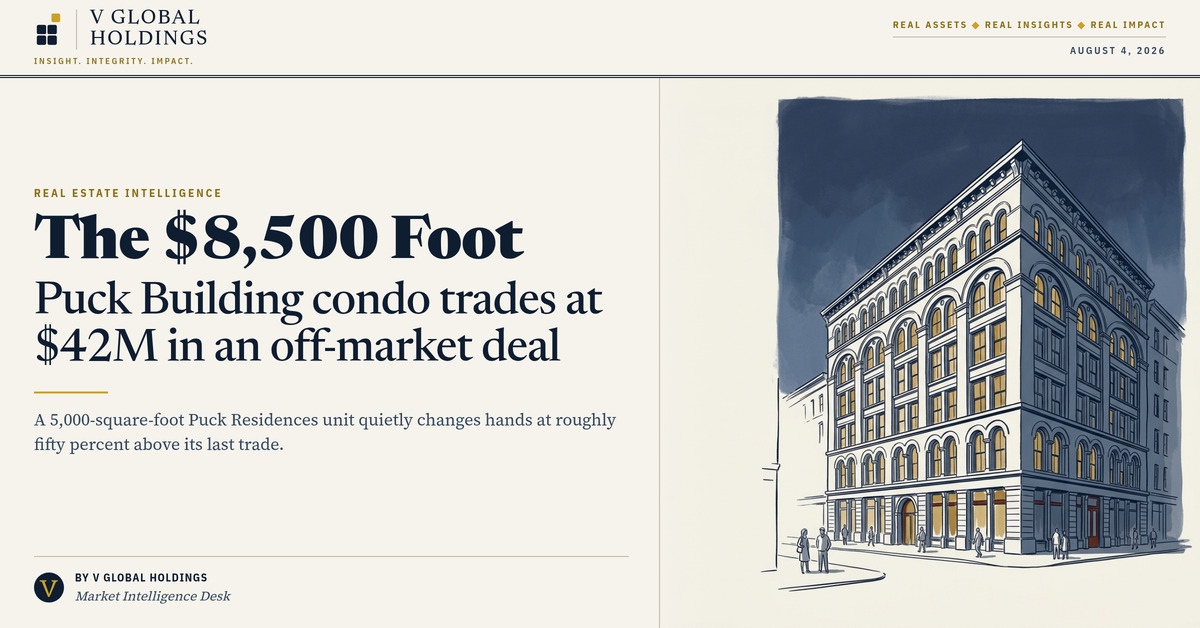
Last week, a 5,000-square-foot condo at the Puck Building — unit 9C at 295 Lafayette Street — traded for $42 million in a fully off-market deal. No listing. No open house. No broker war. Just a quiet transfer between two LLCs, at a number that pencils out to roughly $8,500 per square foot.
If you underwrite Manhattan luxury for a living, that number should stop you mid-scroll. Here’s what you’ll get from the next five minutes: why this trade happened off-market, what the price says about trophy asset liquidity in 2026, and how operators should read it.
The Deal, Stripped to the Studs
The facts are clean:
- Property: Unit 9C, Puck Residences, 295 Lafayette Street, SoHo
- Size: ~5,000 square feet
- Price: $42 million — approximately $8,500/SF
- Seller: Lyford Holdings LLC
- Buyer: An anonymous LLC (identity shielded)
- Deal type: Off-market, no public listing
- History: The unit last traded for roughly $28 million in 2017
Run the math. From $28 million to $42 million is a 50% gross appreciation over roughly nine years — call it 4.6% annualized on an unlevered basis. Not venture returns. But for a single residential asset, in a market that spent half that period being declared dead? That’s a statement.
The Puck Residences were carved out of the landmarked Puck Building by Kushner Companies, which converted the upper floors of the 1885 Romanesque Revival icon into a handful of full-floor penthouses. Scarcity was the product from day one — there are only six units. You cannot build more Puck Building.
Why Off-Market Is the Tell
The most important word in this story isn’t “$42 million.” It’s “off-market.”
When trophy product trades without ever touching StreetEasy, three things are usually true:
- The buyer came to the seller. Demand found supply, not the other way around. That’s a seller’s market dynamic at the very top, regardless of what the broader absorption data says.
- Discretion had value. Both sides used LLCs. At this price tier, privacy isn’t a preference — it’s part of the consideration.
- Price discovery happened privately. The seller was confident enough in the number to skip the marketing process entirely. You don’t do that unless comps — public or whispered — support it.
“The best deals in New York never hit the market. By the time you see the listing, the real buyers have already passed.”
Every seasoned broker in this city has said some version of that line. This deal is the proof.
What $8,500/SF Actually Buys
Context matters. The $8,000–$10,000/SF band in Manhattan has historically been reserved for a short list: 220 Central Park South, 432 Park’s best stack, a handful of Billionaires’ Row penthouses, and the rare downtown landmark conversion.
Downtown trophy product trading in that band — in a loft conversion, not a new-build supertall — tells you the market is paying for three specific attributes:
- Irreplaceability. Landmarked cast-iron architecture with modern systems. The supply curve is a vertical line.
- Floor-plate scale. 5,000 square feet on a single level is nearly impossible to assemble downtown.
- Address as asset. The Puck Building is a brand. Brands compress cap rates and stretch per-foot pricing.
For CRE operators, the read-through is direct: scarcity-driven residential is behaving like core-plus commercial — low velocity, deep-pocketed buyers, pricing power concentrated in assets that can’t be replicated.
The Signal for the Broader Market
One trade is an anecdote. But anecdotes at the top of the market tend to lead the data by two or three quarters. Pair this with what we’re seeing elsewhere in Manhattan — office availability at a six-year low, luxury contract volume holding through the summer — and a pattern emerges:
Capital is rotating back into New York hard assets, and it’s starting at the irreplaceable end of the quality spectrum.
The 2017-vintage buyer of this unit rode out a pandemic, a rate shock, and two tax-policy scares — and still exited 50% above basis. That’s the case study every private wealth advisor will be quietly circulating this quarter.
The Operator’s Takeaway
If you’re underwriting in this market, three actions:
- Track off-market velocity, not just listings. Public inventory data is increasingly a lagging indicator at the trophy tier.
- Re-underwrite scarcity. Landmark conversions, full-floor plates, and brand-name addresses deserve a distinct comp set — blending them with generic luxury understates their pricing power.
- Watch the LLC-to-LLC flow. Anonymous transfer volume is one of the cleanest proxies for institutional and UHNW conviction in New York.
The Puck deal won’t make cable news. But fifty years from now, that building will still be standing on the corner of Lafayette and Houston — and someone will pay another record to own a floor of it.
What’s your read — is $8,500/SF downtown the new benchmark, or a one-off scarcity premium? Drop your take in the comments, and follow for daily breakdowns of the deals moving New York real estate.