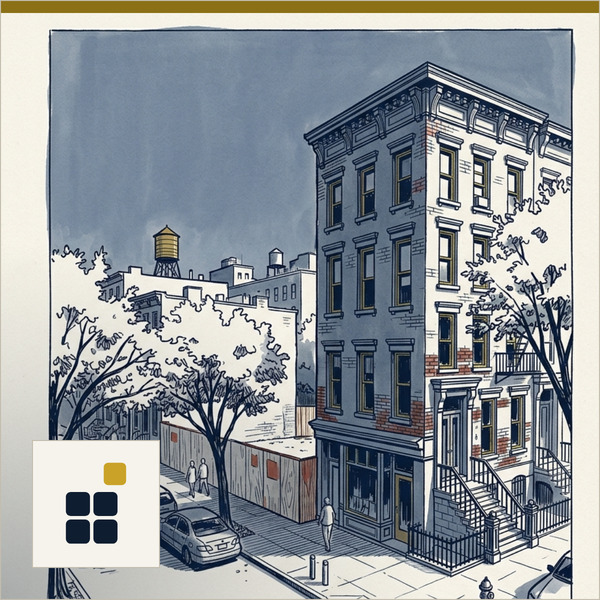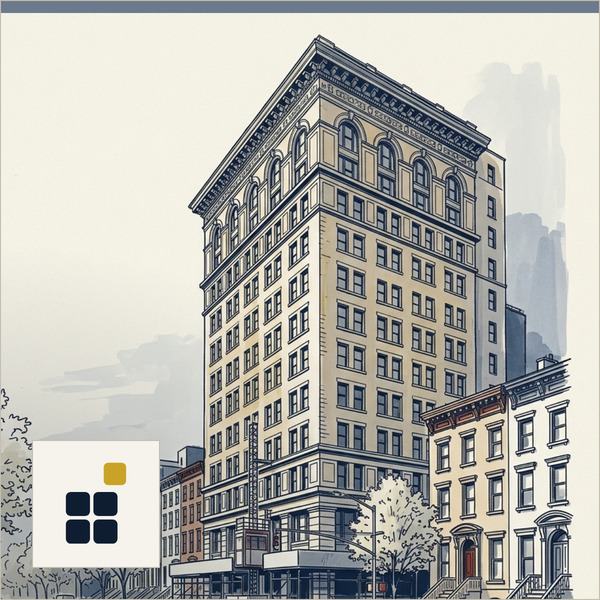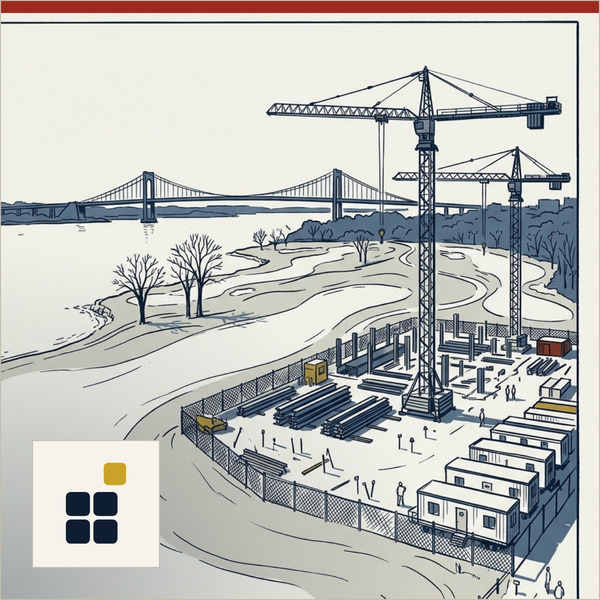
A Great Neck landlord who turned Long Island real estate inside out.
For roughly thirty years, a Great Neck landlord built an $83 million real estate portfolio using a method that required almost no capital, almost no construction expertise, and almost no cooperation from the people who actually owned the buildings. He did it inside the same public systems you and I use every day. The City Register. The Supreme Court. A regional bank’s underwriting desk. A title insurer.
None of them stopped him. Several of them helped.
Last month a Manhattan jury took 90 minutes to convict Joseph Makhani, 63, on three deed-theft-related felonies. Judge Michele Rodney remanded him to Rikers to await a September sentencing. The Real Deal’s investigation — built on 20 interviews, trial testimony, and thousands of public records reviewed over two years — lays out the machinery in detail.
If you own, lend against, insure, or buy New York property, this is not a true-crime story. It is a due diligence memo. Read it that way and you will walk away with a sharper checklist than any title report will give you.
The Numbers That Should Stop You Cold
Start with scale, because scale is what separates a bad actor from a system failure.
- 800+ deed transactions, executed through at least 100 corporate entities, according to pretrial filings
- 52 additional properties beyond the charged conduct showing signs of criminal activity, uncovered by New York Attorney General investigators
- $83,286,000 in personal assets as of 2016, per his own loan application to Flushing Bank
- 184 Makhani-tied properties reviewed, with deeds recorded as early as 2001 showing $0 consideration on some acquisitions
- ~30 buildings still in the portfolio today, per testimony from employee Damian Junor
- 25 conspirators in the 1998 federal foreclosure bid-rigging case — all pleaded guilty
That last one deserves its own paragraph. Makhani’s punishment for participating in an organized scheme to rig public foreclosure auctions was a $20,000 fine and a few months at Otisville. Then he went back to work for another quarter century.
The deterrent was priced in as a cost of doing business. That is the whole story in one line.
The Playbook, In Four Moves
Makhani described his own specialty plainly. He bought “properties that have headaches.”
“Usually it’s not a gamble. It’s a problem that you have to solve.”
Ordinary investors run from murky title chains — abandoned buildings, owners who died without wills, estates fractured among missing or far-flung heirs. Makhani ran toward them. The chaos was the product. Here is the sequence prosecutors described:
1. Find the vulnerable asset. A rotating network of finders and fixers surfaced troubled properties and tracked down people whose signatures might work for a deed transfer. One recurring intermediary, Charles Simon — a notary, pastor, and real estate broker — brought opportunities and, prosecutors said, fronted LLCs used in sham transactions.
2. Manufacture the claim. Deeds in Makhani-linked transactions bore signatures attributed to prison inmates, psychiatric patients, dementia sufferers, Puerto Rican hurricane survivors, and people detectives simply deemed “fictitious.” A 2004 deed transferring a Harlem lot from the Negro Labor Committee carried a purported signature of former president Robert Russell; an archivist compared it to Russell’s known 1971 signature and said the two did not match. The contact number listed on the deed was 555-1212 — directory assistance.
3. Launder the claim through the courts. Move the property from the company tied to the questionable deed into a second LLC, putting distance between the new owner and the original transaction. Then file a quiet-title lawsuit asking a judge to confirm ownership. Anyone with a potential interest is supposed to get notice. Fraud expert Elizabeth Lynch testified that process servers sometimes delivered notices to addresses where recipients did not live — including boarded-up buildings. The practice has a name: sewer service. Nobody appears. Default judgment. Clean title.
4. Monetize. Sell it, flip it, or borrow against it.
Four steps. Each one individually survivable by the system. Stacked, they are close to unstoppable.
Where Institutional Capital Enters The Story
This is the part CRE professionals should sit with longest.
To pull $1.2 million in mortgages on the stolen West 118th Street brownstone, Makhani went to Flushing Bank. His application stated he paid $975,000 for the property. The publicly recorded consideration was $10.
The bank had been lending to him since at least 2002. Flushing’s James Jacovatos testified that Makhani was a consistent re-payer. And critically, the bank held title insurance — paid for by Makhani. If something screwy surfaced about the ownership, the policy would cover it.
Read that structure again. The lender’s risk was hedged. The borrower’s performance was excellent. The economics worked perfectly for both counterparties. The only party absorbing loss was the actual owner, who was not in the room and often did not know the room existed.
Then he gutted 107 West 118th — a former single-room occupancy — and converted it into four market-rate rentals at roughly $3,300 per month.
The stolen asset became a performing asset. That is the alchemy, and it is the reason the scheme ran for three decades.
The Litigation Flywheel
Winning in court against Makhani was frequently not the same as winning.
Take 237 Maple Street in Prospect Lefferts Gardens. A long-vacant lot, held on paper since 2003 by two LLCs registered at Makhani’s Jamaica, Queens operations hub. Neighbors got no response to inquiries, so in 2012 they built the Maple Street Community Garden. Two years later Makhani arrived with a crew to rip up a garden bed. Police told him to come back with a court order. He is still trying.
A judge ruled in 2015 that the 2003 deed was “of dubious validity.” The Parks Department eventually condemned the parcel for $2.3 million. Attorneys located the real heirs of Germaine Kirton, the last verified owner, and argued Makhani’s deed was signed by fictitious heirs a genealogist could not confirm ever existed. Judge Wayne Saitta agreed in a 2025 ruling.
Makhani appealed — for a 49 percent share.
Or consider Diane Prince. Makhani paid $136,000 for partial deeds giving him a 75 percent stake in her family’s $695,000 Queens home of 55 years, then sued to force a buyout at $500,000. Barring that, he demanded rent as a co-owner while paying no maintenance or taxes. Prince won. New York banned those partition actions in 2024. And Makhani remains, on paper, a 75 percent owner — now trying to install a stranger in the home on a lease.
Legal Aid’s Gerard Deenihan captured the deterrent effect exactly:
“They’re like, ‘You cannot fight this guy because he will crush you. He will never back down.'”
That quote is the actual business model. Not the forgeries. The exhaustion.
The Structural Gap Nobody Has Closed
Makhani may be going to prison. The mechanics are not.
State law still requires the City Register to record any deed that arrives in complete, recordable form. The clerk does not verify. The clerk records. Residential attorney Gordon Remer put it bluntly:
“If you’re willing to be a criminal and put forward fraudulent papers, you can pretty much get title to anything, real-estate wise.”
And the playbook kept running right up to the verdict. Makhani did not attend collaborator Charles Simon’s 2014 funeral — but soon after, he sued Simon’s heirs to close a 2013 deal Simon supposedly made to sell his Queens bungalow for $150,000. Default judgment. The children lawyered up, saying they were never served; his daughters called the contract “bogus” and “a forgery.” Makhani hit the estate with an additional $1.35 million suit. The family stopped showing up. Another default. The Sheriff’s Office was ordered to execute a deed, recorded at a purchase price of $10.
The Fresh Meadows house sold on July 9, 2026 — the week after the guilty verdict — for $1.3 million.
Your Actual Takeaways
For operators, lenders, and acquisitions teams in this market:
- Chain-of-title depth beats chain-of-title cleanliness. A default quiet-title judgment closes the chain on paper. Go back further than the judgment and ask who didn’t appear, and why.
- Treat $0 and $10 recorded consideration as a hard stop, not a curiosity. It appeared repeatedly across 184 properties.
- Audit service of process on any quiet-title predecessor. Sewer service is the single load-bearing step in the whole scheme.
- Title insurance transfers your risk — it does not validate the asset. Flushing Bank was made whole in theory. Veronica Palmer’s brownstone was still gone.
- Map the entity, not the name. 100 LLCs, variant spellings (McKani, McKhani, McKany), and employees installed as temporary officers defeat any name-based screen.
- Distressed-estate acquisitions deserve a genealogist, not just a title abstract. That is what finally broke 237 Maple Street.
The Bottom Line
New York’s recording system is built on a presumption of good faith that has not been true for at least thirty years. Makhani did not hack anything. He read the rules carefully, found the seams, and industrialized them — while regulators, banks, insurers, and courts each performed their narrow function correctly and collectively produced an $83 million fraud.
The conviction is a headline. The gap is still open.
If you are underwriting a New York acquisition this quarter, pull the full chain — not the summary — on every parcel with a quiet-title judgment or a nominal-consideration deed in its history. Then tell me what you find. I want to hear which of these patterns is still sitting in live deal flow, because the honest answer is that most of us have never looked.
What is your firm’s actual policy on nominal-consideration deeds in the chain? Drop it in the comments — this is a conversation the industry has avoided for three decades.