
If you own, underwrite, or manage a 421a building in New York City, the lawsuit filed Wednesday in New York State Supreme Court is not somebody else’s problem. It is a stress test of an assumption baked into thousands of rent rolls across the five boroughs.
Here is what you will get from the next ten minutes: a clear read on the specific claim, the precedent that gives it teeth, the arithmetic of why the exposure number is so large, and a practical checklist for finding out whether your own portfolio carries the same defect.
Let’s get into it.
What Actually Happened
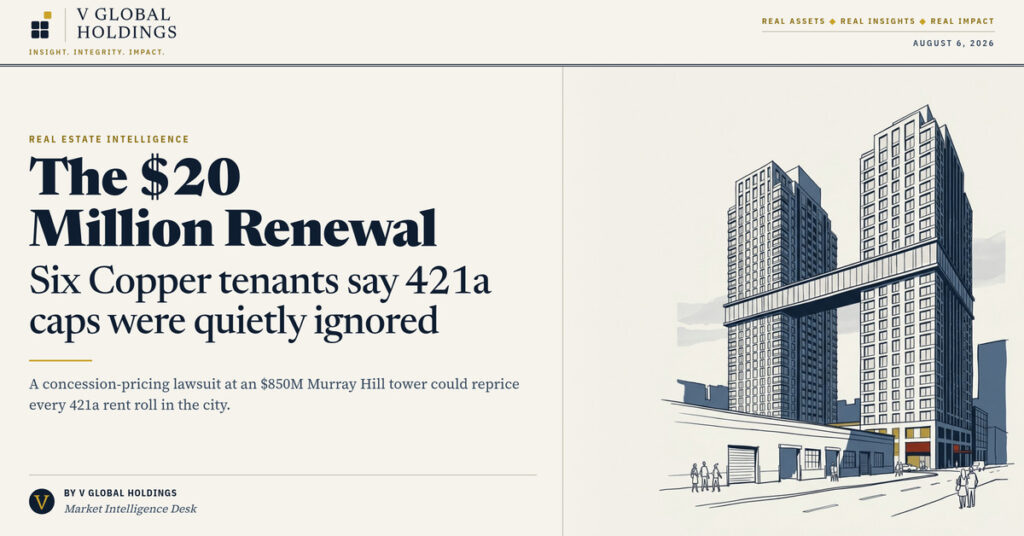
Six tenants at The Copper — the pair of conjoined luxury high-rises at 626 First Avenue in Murray Hill, formerly known as the American Copper Buildings — sued the property’s management on Wednesday. The defendant is Josh Gotlib’s Black Spruce Management.
The allegation is specific: tenants received lease renewals priced up to nearly 20 percent above the net effective amount they paid during their initial lease term. Their units are rent-stabilized under 421a, which means increases are not a matter of market judgment. They are set by the Rent Guidelines Board.
For the relevant period, the RGB caps were:
- 2.75 percent on one-year renewals
- 5.25 percent on two-year renewals
And those caps are about to get tighter still. The board recently voted to approve a historic rent freeze, which takes the allowable increase to zero.
Twenty percent against a 2.75 percent ceiling is not a rounding error. It is a different pricing model entirely.
The plaintiffs put the aggregate overcharge at more than $20 million.
The Asset Behind The Headline
Context matters here, because this is not a marginal building operated by a marginal sponsor.
- Black Spruce bought the two towers for $850 million in 2021, from Michael Stern’s JDS Development Group and the Baupost Group
- The development contains 761 units
- 20 percent of those units are stabilized under 421a
- The proposed class could sweep in over 3,500 potential members — every stabilized tenant in the development who received a renewal increase exceeding the RGB limit
Read that last bullet twice. The class definition is not limited to the six named plaintiffs, and it is not limited to current tenants. It reaches back across the ownership history of the building.
The Mechanic At The Center Of The Case
This is the part worth understanding properly, because it is the part that generalizes.
The claim is not that a landlord simply typed a bigger number on a renewal. It is about preferential rents and concession pricing — a practice that has been standard operating procedure in New York lease-up for years.
The alleged sequence works like this:
- Advertise the unit at an attractive net effective rent — the number the tenant actually feels
- Deliver that number using a concession, most commonly one month free on a twelve-month lease
- Register a higher legal rent with the state housing authority — the gross number, before the concession
- At renewal, apply the RGB increase to the registered legal rent, not the net effective rent the tenant had been paying
The tenant experiences a jump far larger than 2.75 percent, because the concession silently disappeared from the base. On paper, the landlord applied a compliant percentage. In the tenant’s bank account, the rent went up by a fifth.
Landlords have consistently argued that concessions are ordinary market practice and that the registered rent is the legal rent. Tenant advocates call the same structure illegal rent inflation.
Both positions have won before. Some earlier 421a overcharge suits have been dismissed outright.
The Precedent That Changes The Math
What makes this filing more dangerous than the 2021-era wave is the case law the plaintiffs are standing on.
Housing Rights Initiative, the nonprofit tenant advocacy group whose research underpins the suit, cited Grey v. LIC Development Owner LP. That decision held that any building offering rent concessions on stabilized units after the Housing Stability and Tenant Protection Act of 2019 must maintain that concession in all renewal leases going forward.
“Defendants, and their predecessors-in-interest, have evaded the 421-a Program’s requirements, and governing rent-stabilization laws, by failing to abide by the rent regulations with respect to ‘preferential rents.'” — from the complaint filed in New York State Supreme Court
If Grey holds and travels, the concession is not a one-time marketing expense. It is a permanent feature of the rent base. Every renewal from that point forward compounds off the discounted number, not the registered one.
That single distinction is the difference between a compliant rent roll and a $20 million liability.
Note also the phrase “predecessors-in-interest.” The plaintiffs are reaching through the 2021 transaction. A buyer who acquired an asset with this structure already embedded may inherit the exposure along with the keys.
This Is A Campaign, Not An Incident
Newman Ferrara LLP filed the suit. Housing Rights Initiative supplied the research. That pairing has a track record — HRI has functioned as a longtime 421a watchdog, running investigations that convert into litigation on a repeating cadence.
The operator lesson is not “one building got sued.” It is that a well-funded research organization is systematically auditing public rent registration data against advertised net effective rents, and the gap between those two numbers is machine-detectable at scale.
If your building shows that gap, you do not need to be the target of a complaint to already be on a list.
The Operator’s Checklist
Concrete work you can do this week, regardless of whether your name appears in any filing:
- Pull your 421a registration history. Compare the registered legal rent against the advertised net effective rent for every original lease-up. The delta is your exposure surface.
- Date your concessions against HSTPA. Grey applies to concessions offered after the 2019 law. Pre-2019 lease-ups sit on different ground.
- Rebuild renewal math off net effective. Model what your NOI looks like if the concession is treated as permanent and RGB increases compound off the discounted base.
- Stress the rent freeze. With the RGB approving a freeze, the allowable increase goes to zero. If your pro forma assumed 2.75 percent annual step-ups on the stabilized 20 percent, that line is now flat.
- Audit acquisitions, not just originations. “Predecessors-in-interest” language means diligence on a 421a asset must reach back to original lease-up documents, not just current rent rolls.
- Check the class math. A 761-unit building with 20 percent stabilization produced a proposed class of 3,500-plus. Turnover multiplies the class far beyond the current unit count.
The Pattern Around The Defendant
For completeness, because underwriting is also about counterparty read: The Copper has been litigated before. A 2019 suit against Stern’s JDS alleged Fair Housing Act Amendments violations — doors too narrow, mailboxes mounted too high. The parties settled for $2.9 million in 2021. Stern and Gotlib were later accused of failing to complete required accessibility upgrades by a March 2023 deadline, producing a second settlement with an $800,000 penalty plus fines for violations persisting past the deadline.
Separately, Gotlib is defending a case brought by Natalia Legg, widow of Black Spruce co-founder Oliver Legg, over her stake in the firm. Gotlib claimed in June that a “secret recording” rebutted her account. That case is now stayed pending arbitration.
A spokesperson for Black Spruce did not immediately respond to a request for comment on the filing.
The Bottom Line
The claim here is not exotic. It is the most common lease-up structure in New York City, tested against a 2019 statute and a 2019-era precedent that most pro formas were written before anyone had read.
Twenty percent versus 2.75 percent. Registered rent versus net effective. One building, $20 million, 3,500 potential class members — and a concession playbook that has been running citywide for the better part of a decade.
If your 421a rent roll was built on net effective marketing, go find out which number your renewals compound off of. Do it before someone else does it for you — and if you already know the answer, say so in the comments. I want to hear how other operators are modeling the freeze.