
Here’s what you’ll take away from the next five minutes: a working understanding of how a $1 million apartment can hold up an 850,000-square-foot office tower, why condo bylaws are quietly one of the most powerful instruments in New York development, and how to read the Rosen–Holliday feud as something more useful than gossip.
Because this isn’t a lawsuit story. It’s a control story.
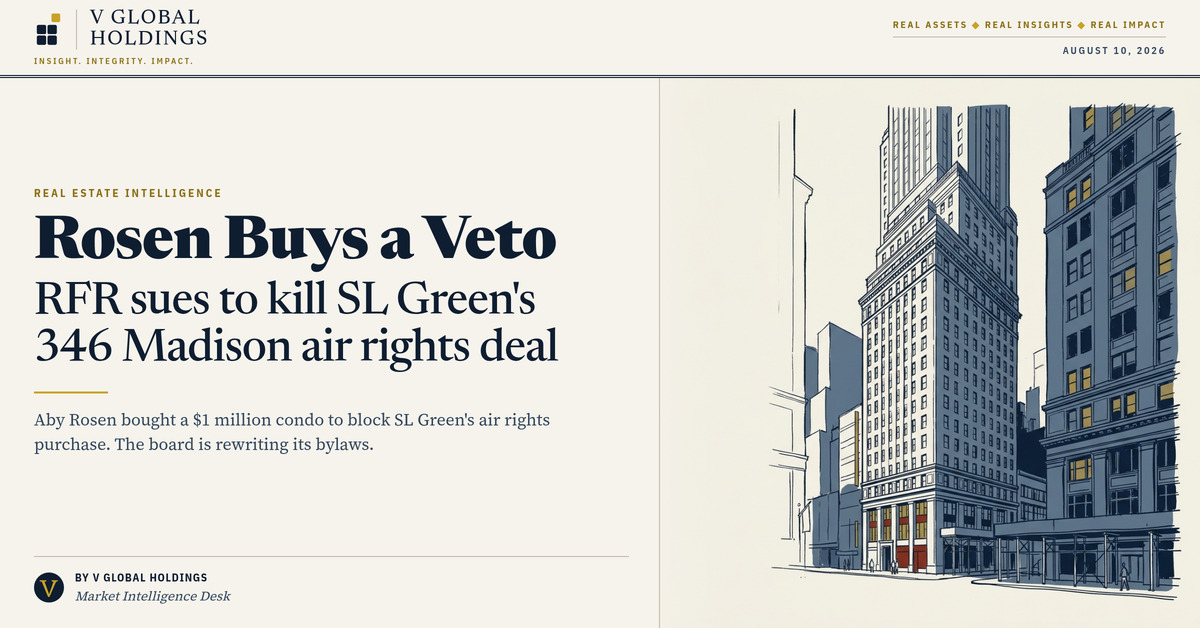
On Friday, Aby Rosen’s RFR filed suit in Manhattan Supreme Court asking a judge to void a contract and freeze a condo board mid-vote. The building in question is not a trophy. It’s 5 East 44th Street — a residential condo most of the industry could not place on a map. And it currently sits astride one of the most valuable development plays in Midtown East.
The Setup: What SL Green Actually Bought
Start with the asset, because the asset explains the aggression.
In November, Marc Holliday’s SL Green bought 346 Madison Avenue — the former Brooks Brothers flagship — together with the adjacent building at 11 East 44th Street, for $160 million. The REIT plans a roughly 850,000-square-foot office tower on the assembled site.
That plan needs air. Specifically, it needs the unused development rights sitting above the neighboring condo at 5 East 44th Street.
Here’s the number that makes this fight rational: the condo has roughly 3,600 square feet of unused air rights. Run through the Midtown East rezoning bonus, those 3,600 square feet could generate approximately 37,000 square feet of development rights.
Read that multiple again. Roughly ten to one.
That is the whole game. In a rezoning designed to channel density toward Grand Central, a small pocket of unused air above a modest condo becomes a lever with outsized mechanical advantage. This is why sophisticated operators treat air rights not as a rounding error but as a distinct asset class with its own comps, its own scarcity curve, and — as we’re seeing — its own choke points.
The Move: Buying the Smallest Possible Seat at the Table
Now the part that deserves genuine professional respect, whatever you think of the man making it.
In December, Rosen’s RFR bought a $1 million apartment inside 5 East 44th Street.
Ask the obvious question. Why would a developer known for high-end art and a private yacht want a modest Midtown condo unit? He didn’t. He wanted what came attached to it.
The condo’s bylaws required unanimous approval from all owners to move forward with a sale of the building’s air rights. Buy one unit, acquire one vote, and — under a unanimity rule — that single vote is functionally a veto over a transaction worth many multiples of the purchase price.
For roughly $1 million, Rosen bought the ability to stall a deal feeding an 850,000-square-foot tower. As pure option economics, that is a remarkably cheap position.
And he didn’t stop at blocking. Rosen made a competing bid:
- RFR’s offer: $6.5 million for the air rights
- SL Green’s offer: $6 million — $500,000 less
- RFR’s deposit: 20 percent, versus SL Green’s 10 percent
More money. Harder deposit. The board still said no.
The Counter: Rewriting the Rules Mid-Game
The board’s response was the elegant one. Rather than litigate the veto, it moved to eliminate it.
A special meeting is scheduled for August 13, where the board intends to amend the bylaws to permit a supermajority — rather than unanimity — to approve the sale to SL Green. Change the threshold, and Rosen’s single unit stops being a veto and becomes just a vote. Outvoted.
RFR’s complaint is aimed squarely at that maneuver:
“This action arises from a rogue board that is acting well beyond the bounds of its authority. [RFR] brings this action . . . to hold the board accountable to the condominium’s governing documents, and effectively right the ship.”
SL Green’s spokesperson was considerably less diplomatic, calling the suit frivolous and insisting 346 Madison remains on track and on schedule:
“We view this as straight out of the Aby Rosen playbook — losing out on a deal and suing everyone in sight.”
A representative for the condo board could not immediately be reached.
The Twist: An Offer to Merge the Fight
Then Rosen did something genuinely unexpected. Having sued, he floated a partnership.
Rosen owns 350 Madison Avenue, directly next door to SL Green’s site. His pitch:
“As a unit owner in the condominium, we believe in transparency from the board and will protect the best interests of every owner in the building. Separately, while we are very excited about both SL Green’s development at 346 Madison Avenue and our project at 350 Madison Avenue next door, we believe it would be a great thing for the city for us to join forces and deliver one supertower that is of much greater scale and efficiency.”
Set aside the personalities and the site-assemblage logic is real. Two adjacent development parcels, combined, produce a floorplate and an efficiency profile neither achieves alone. In a Midtown East pipeline this thin, one supertower probably does beat two constrained neighbors.
Whether that’s a sincere olive branch or leverage dressed as civic-mindedness is a judgment call. Both readings are defensible. Both are probably partially true.
Why This Is Personal: A Three-Round History
This fight has a ledger, and it runs against Rosen.
- 522 Fifth Avenue. RFR fell behind on the mortgage for the 23-story vacant office building and went into foreclosure. SL Green bought the debt at a significant discount — roughly 40 percent off — and pressed the foreclosure. The parties settled; RFR later sold the building to Amazon and framed it as a win. The taste it left was evidently something else.
- 346 Madison. Rosen tried to buy the site. SL Green closed it. Rosen sued the seller — Luxottica heir and former Brooks Brothers CEO Claudio Del Vecchio — alleging RFR’s confidential information was used to steer the deal. That litigation is ongoing.
- Building access. Rosen allegedly refused SL Green access to 350 Madison to shore up the building during demolition next door. SL Green sued RFR in June.
Now the air rights. Four rounds, one continuous campaign.
The Operator’s Takeaways
Three things worth carrying into your own deals:
- Governance documents are development risk. A unanimity clause in a condo’s bylaws is a structural feature of the site next door. Diligence that stops at the property line is incomplete diligence.
- Small positions buy large optionality. A single unit, bought cheaply, converted into a veto over a nine-figure development program. Cheap options on choke points are the most underpriced instrument in New York real estate.
- Air rights compound. Under the Midtown East bonus, 3,600 square feet became a claim on roughly 37,000. Zoning math, not land math, is what you’re actually buying.
The August 13 meeting is the near-term event to watch. If the bylaws get amended and survive challenge, the veto evaporates and 346 Madison proceeds. If a judge freezes the amendment, a modest condo board becomes the gatekeeper of a Midtown supertower — and every developer in this city will re-read the bylaws of every building adjacent to every site they own.
Which is the better outcome for New York: two constrained towers, or one that actually works?
If you’re underwriting a Midtown East assemblage right now, pull the condo docs on every neighbor before you pull the comps. That’s the lesson, and it’s cheaper to learn here than in court.