

The most instructive development story in Queens this week is not a $2 billion project. It’s a 48,000-square-foot lot on Steinway Street — and the fact that it is moving while the $2 billion project next door is not.
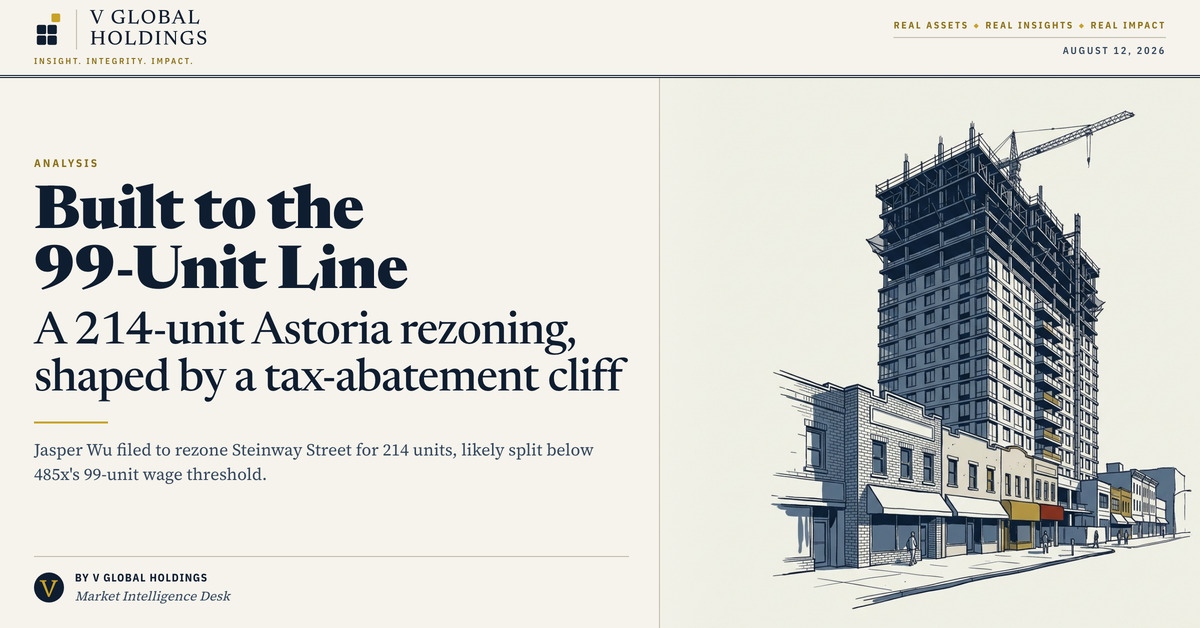
Jasper Wu’s ZD Jasper Realty filed to rezone 34-49 Steinway Street from commercial to mixed-use, clearing the way for a 17-story, 214-unit building. It sits a few blocks from Innovation QNS, the five-site, 3,200-unit megaproject that got approved and then fell apart.
What follows is the actual economics: the site basis, the 485x structuring move that shapes the building’s physical form, and why a fragmented development landscape may be a feature rather than a failure.
The Project on Paper
Straight from the application filed with the City Planning Department, first reported by PincusCo:
| Metric | Figure |
|---|---|
| Site area | 48,000 sf |
| Proposed building | 171,000 sf |
| Height | 17 stories |
| Units | 214 |
| Affordable share | ~25% under Mandatory Inclusionary Housing |
| Retail | 21,000 sf |
| Community space | ~5,000 sf |
| Land basis | $16.6M, acquired 2024 from Robert Gans |
Run the basis: $16.6M against 171,000 buildable square feet is roughly $97 per buildable foot. Against 214 units, about $78,000 per unit of land cost. For a rezoning-dependent Queens site bought in 2024, that is a number you can build a rental deal around — provided the rezoning lands.
That conditional is doing real work. Wu is buying entitlement risk at a price that assumes he wins it.
The 485x Tell — Read the Building, Find the Policy
Here is the detail most coverage skips, and it’s the one that tells you how New York actually gets built right now.
ZD Jasper’s own website calls this a rental. And a 214-unit rental will “likely be split into multiple buildings with 99 units or fewer” — specifically to dodge the construction wage requirements imposed by 485x.
Sit with that. The physical form of the building is being determined by a threshold in a tax abatement statute. Not by the site. Not by the market. Not by design. By the number 99.
This is not a loophole discovered by one clever developer — it is now the dominant pattern. The 99-unit building is what happens when policy sets a cliff instead of a slope, and it produces a predictable set of consequences:
- Two or three buildings where one would have been more efficient
- Duplicated cores, lobbies, and mechanicals — real cost, no tenant benefit
- Wage requirements avoided at exactly the scale they were written to capture
- A city full of 99-unit buildings, which is a strange thing to have legislated into existence
ZD Jasper is already running the playbook a block south: a separate 99-unit project at 35-25 Steinway Street.
Whatever you think of prevailing wage policy, note the mechanism. Threshold rules don’t reduce the activity above the line — they relocate it just below.
What Innovation QNS Actually Proved
The megaproject next door is the necessary context.
Innovation QNS was a five-site, 3,200-unit development from Silverstein Properties, BedRock Real Estate Partners, and Kaufman Astoria Studios. The City Council approved the rezoning in November 2022 — a genuine political win, hard-fought, at roughly $2 billion in scale.
Then the development team broke up. The site is now yielding a series of smaller developments instead — including the $250M LMXD/BedRock land deal for one of the pieces, which closed just last week.
The lesson isn’t “megaprojects are bad.” It’s more specific and more useful: entitlement and execution are separate risks, and the market has been repricing the gap between them. Innovation QNS cleared the political hurdle — the hard one, the one everyone assumes is fatal — and still didn’t get built. Interest rates moved. Construction costs moved. The partnership structure that made the assemblage possible didn’t survive the change.
A 214-unit building on a single 48,000-sf lot has a materially different risk profile. One owner. One capital stack. One decision-maker. If rates move, one person decides whether to proceed.
ZD Jasper’s Wider Book
Wu isn’t making a single bet — he’s running a Queens-weighted portfolio with several distinct approaches live at once:
- 34-49 Steinway Street — this 214-unit rezoning
- 35-25 Steinway Street — a 99-unit project a block south
- 45-40 Vernon Boulevard, LIC — a 182-unit condo at a former paint factory, nearing completion
- Sunnyside — a 143-unit project that made ZD Jasper the first NYC developer to use new state environmental-review exemptions, moving forward without additional SEQRA review
- Upper East Side — a branded condo project targeting completion by summer 2027
That SEQRA item deserves more attention than it’s getting. Being first through a new procedural exemption is its own competitive edge — the firms that learn a new approval pathway early get a timeline advantage that compounds across every subsequent filing. While competitors are still reading the guidance, you’re already in the ground.
Entitlement expertise is an asset class. ZD Jasper is accumulating it deliberately.
What the Operator Takeaways Actually Are
Three things I’d act on:
- Underwrite the 99-unit structure explicitly. If you’re modeling a New York rental deal above that threshold, model both paths — one building with wage requirements, multiple buildings without. The answer is site-specific, and the split isn’t free. Duplicated cores cost real money.
- Look at the ground around failed megaprojects. Innovation QNS cleared the political path through Astoria and then vacated it. The rezoning precedent, the community process, the infrastructure conversation — all of it survives the project that died. Wu is filing into softened ground.
- Track the procedural first-movers. ZD Jasper’s SEQRA exemption play tells you where approval timelines are compressing before it shows up in anyone’s underwriting.
Astoria is going to get built. Just not the way the City Council approved in 2022 — in 214s and 99s, by operators with single-decision-maker capital stacks and a working knowledge of which threshold to stay under.
Are you structuring around the 99-unit line on your current deals — and is the split actually penciling once you count the duplicated cores? I’d like to hear real numbers from people running the model.