

Most New York real estate players want you to know their name. The Stellbergers, who are behind Happier Grocery, are the opposite.
These two have built a portfolio out of making sure you don’t.
This week, The Real Deal pulled the curtain back on Dawson and Wells Stellberger — two former soccer-star brothers from Crested Butte, Colorado, who are the names behind Happier Grocery, the buzzy Soho market on Canal Street. And they just showed up in Carroll Gardens with $21.5 million.
If you buy, lease, or lend in Brooklyn, this story is worth your ten minutes. Not because of the celebrity sightings — though there are some — but because the Stellbergers have quietly assembled one of the more coherent adaptive reuse playbooks in the city, and they’ve done it without a website, an office, or a press strategy. Here’s what was reported, what the portfolio looks like, and what I’d take from it.
The Deal That Started the Guessing
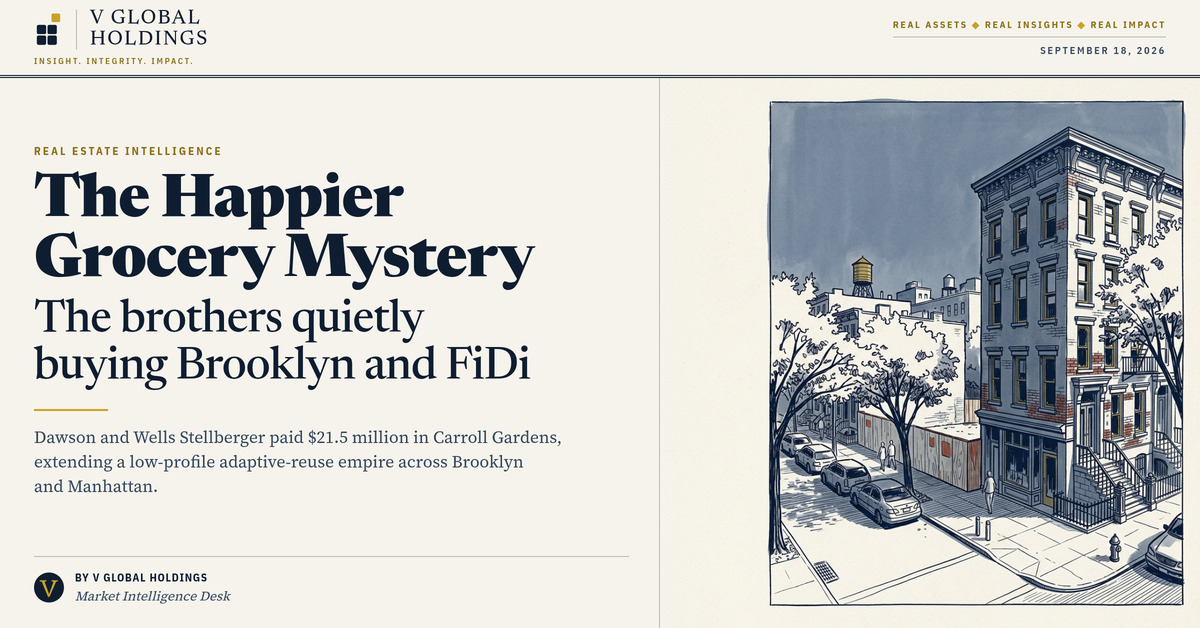
An entity tied to Dawson Stellberger paid $21.5 million for a mixed-use building at 291 President Street and an adjacent development site at 336 Union Street, in the leafy brownstone-lined Brooklyn neighborhood.
The buyer’s name is the tell: Happier Grocery President LLC. That naming suggests the brothers could be plotting a Brooklyn outpost of their grocery-slash-community space. It is a suggestion, not a confirmation — the Stellbergers did not respond to requests for comment.
The structure is where it gets interesting. The purchase was made in care of 99c Capital Partners, which adds another layer to an already opaque deal. And the address listed on the deed traces back to a post office box nearby.
That is not an accident. It is a pattern.
The Real Estate Brother
Dawson is the founder of Bushwack Capital, a New York-based real estate firm that has developed more than 25 multifamily and industrial properties in Brooklyn, according to a 2024 NYC Economic Development Corporation filing. His portfolio mixes residential, industrial, and commercial — mostly in Brooklyn.
Two early deals define the method:
- 599 Johnson Avenue, Bushwick — a former furniture warehouse that Bushwack transformed into a 24,000-square-foot space that houses the live music venue Elsewhere.
- 154 Scott Avenue — a former steel factory, repositioned as a membership club with co-working space, production studios, dining, health and wellness facilities, and a members-only club called SAA.
Note the through-line. Neither was a teardown. Both were buildings nobody else wanted, re-tenanted with something that draws a crowd.
Dawson described the strategy himself in a 2024 New York Times article: he seeks out buildings that are “out of favor” and finds ways to “activate them and build community.”
That thesis carried him to the Financial District and 175 Water Street, the 31-story tower now known as WSA. An ownership group including Stellberger and London-based real estate developer Matthew Khalil transformed the office building into an unconventional hub for fashion, arts, technology, and other creative tenants. Its events have drawn Kendall Jenner and Bad Bunny.
The Creative Brother
Wells took the other door in.
He worked for years as a designer at Marc Jacobs before moving into hospitality and nightlife, according to the New York Times. In 2016 he opened the Bushwick event space 99 Scott with art industry veteran Molly McIver. The pair later opened the since-shuttered Brooklyn restaurant Outerspace.
Then came Happier Grocery. The Canal Street store opened in 2023, selling food and wellness products, and includes an event area known as the Apartment, where it has hosted dinners, yoga, and workshops.
Both Happier Grocery and WSA sit under Happier People Management, a hospitality management and staffing company founded in 2020. The group also operates SAA, 99 Scott, and Bright Eye Production, a catering kitchen, according to the Times.
So one brother buys the box. The other fills it. That is the whole company.
The 99c Connection
Here is where the story stops being a neighborhood profile and starts being a capital markets story.
99c Capital Partners has been snapping up buildings in Manhattan and Brooklyn in recent years, according to property records. The LLC owns at least 10 commercial buildings across the two boroughs. Stellberger has previously confirmed to TRD that he is a partner at 99c.
The firm is associated with Quebec businessman Carlo Bellini. Its footprint, as reported:
| Asset | Detail |
|---|---|
| 175 Water Street | The former AIG building, now WSA |
| 180 Maiden Lane | A 41-story office tower |
| 110 Wall Street | Rudin’s tower — under contract, per The Promote |
| Portfolio | At least 10 commercial buildings, Manhattan + Brooklyn |
| Carroll Gardens | $21.5M — 291 President St + 336 Union St |
And one more thread: in 2022, sources told TRD that billionaire Ken Dart was part of a group of high-net-worth investors that Bellini and Stellberger raised funds from in the U.K. Dart later dropped out of the investment group.
How two brothers from Crested Butte connected with the Dart and Bellini families remains a mystery.
What the Playbook Actually Is
Strip out the mystique and the model is legible:
- Buy the out-of-favor asset. Warehouses, steel factories, a discounted FiDi office tower. Basis first.
- Don’t demolish — activate. Elsewhere, SAA, WSA, the Apartment. The capex goes into programming, not a new envelope.
- Own the operator. Happier People Management means the tenant and the landlord are the same people. No leasing risk on the anchor.
- Stay invisible. No website. No physical location. A P.O. box on the deed.
Point three is the one most operators miss. Vertical integration on the hospitality side means they can underwrite a building nobody can fill, because they’re the ones filling it.
“We like to kind of remain in the background. I think there are a lot of big personalities in New York City real estate and hospitality. It’s just not sort of our ethos.” — Dawson Stellberger, to the New York Times
My Read
Two things stand out to me.
First, the grocery-as-anchor thesis is a real answer to a real problem. Retail leasing in a brownstone neighborhood is brutal for a landlord with no operating arm. If you own the grocery concept, a mixed-use building at 291 President Street underwrites very differently than it does for a passive buyer bidding the same $21.5 million.
Second, the adjacent development site at 336 Union Street matters more than the headline building. Buying an operating asset plus the lot next door is how you control your own expansion — and your own light and air. That is a land-assemblage move dressed up as a grocery story.
What I can’t tell you is who else is in the deal. The buyer structure leaves that open, and the reporting is honest about the limits of what property records show.
Your Move
If you’re a Brooklyn owner: the next bidder for your out-of-favor building may not be a developer at all. It may be an operator who can fill it. Price accordingly.
If you’re an investor: watch 110 Wall Street. If that contract closes, 99c’s Manhattan footprint stops being a curiosity and starts being a platform.
I’d love to hear from the operators in this group — has an owner-operator outbid you on an asset you’d already penciled? Drop it in the comments. That’s the trend worth tracking here.