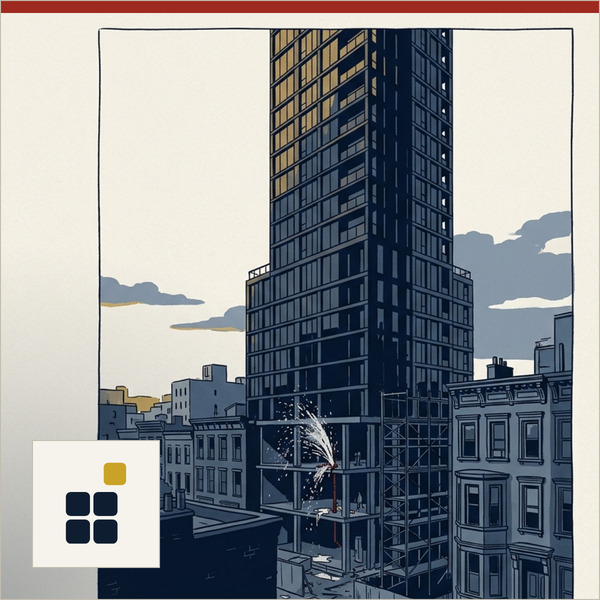
A water pipe burst at Brooklyn’s tallest tower in 2022. Four years later, the insurance check from that leak has cost Michael Stern an arbitration.
An arbitrator has ordered Stern and JDS Development to pay Silverstein Capital Partners (SCP) $46.9 million. The finding: JDS concealed a $35.4 million insurance payout from its lender. It also couldn’t show where $13.1 million in loan advances meant for vendors actually went.
If you lend on construction, borrow on construction, or sit anywhere in a mezzanine stack, read this one closely. It isn’t really a story about one developer’s bad week. It’s a field guide to the clauses that decide who owns the money when a project goes sideways. I’ll walk through what the arbitrator found, what he threw out, and what I’d change in my own loan docs because of it.
The Tower Behind the Fight
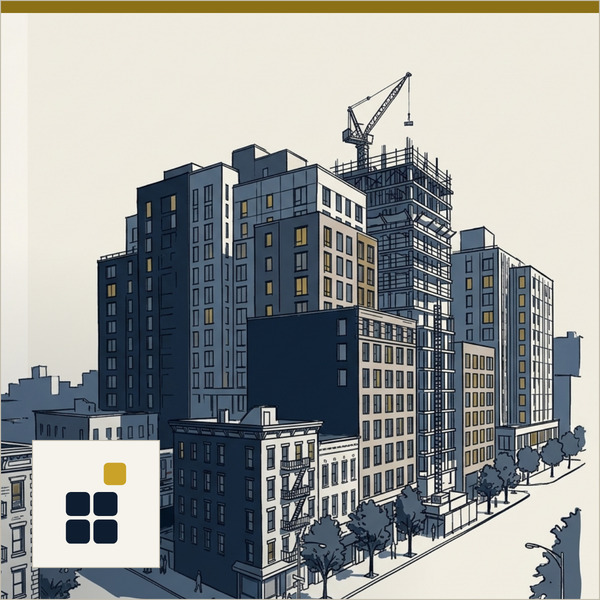
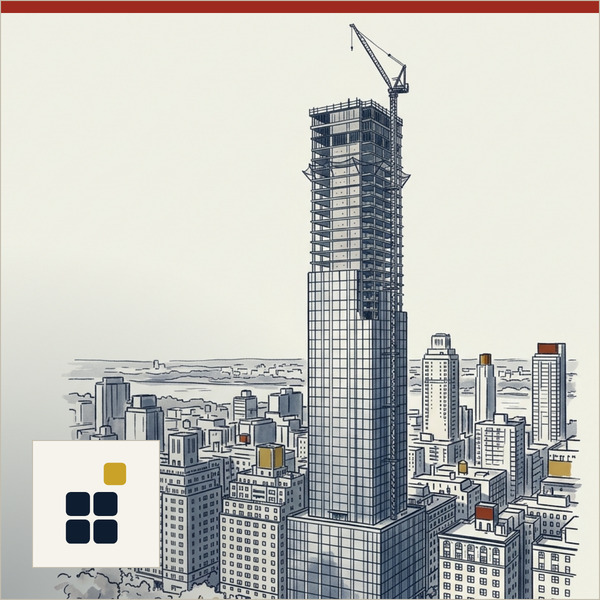
The building is the Brooklyn Tower at 9 DeKalb. It stands 1,066 feet tall, and Brooklynites call it the Tower of Sauron.
The capital stack, per TRD:
| Item | Detail |
|---|---|
| Total debt package | $664 million (April 2019) |
| SCP’s mezzanine piece | $240 million |
| Mezz share of the debt (my math) | ~36% |
| JDS default | 2023 |
| Handover to Silverstein agreed | June 2024 |
| Arbitration award | $46.9 million + 9% annual interest from September 2024 |
SCP is the lending arm of Silverstein Properties. When JDS defaulted in 2023, SCP entered forbearance agreements, then bought the senior loan and started foreclosing on the mezzanine loan. By June 2024 the two sides agreed to hand the property to Silverstein instead.
That should have been the end of it. It was the beginning.
Where the Insurance Money Went
The handover required JDS to account for how the loan proceeds were spent. JDS didn’t provide that accounting, according to arbitrator Eugene Farber, who was appointed by the American Arbitration Association. SCP started an arbitration to force one. Farber found that JDS didn’t comply with his order either.
The key document was the insurance file. Stern didn’t produce it until Farber warned him in March 2026 about possible negative consequences. When it surfaced, Farber wrote, it showed Stern had “wrongfully diverted and taken” the insurance proceeds.
Stern’s defense had two parts:
- Soft costs. He argued it was an “obvious fact” that a developer could keep some insurance proceeds from insurer CNA to cover delays and other soft costs.
- Wrong entity. He argued that JDS Construction, not the borrower entity, was the insured party, and that it wasn’t part of the handover agreement.
Farber rejected both. The lender had a security interest in the proceeds under the loan agreement. And the insurance checks were made payable to both JDS Construction and the borrower entity.
Stern also alleged SCP deliberately underfunded the project to take control of it. That argument didn’t carry the day either.
What SCP Didn’t Get
This wasn’t a clean sweep for the lender. Farber rejected millions of dollars of SCP’s claims.
One example: SCP wanted $12.5 million held as a reserve against a lawsuit brought by BNP Paribas. Farber found that BNP’s deal to buy units wasn’t covered in the term sheet, so the reserve claim failed.
That’s worth noting. Arbitrators read the documents, not the narrative. SCP won where the loan agreement spoke clearly and lost where it didn’t.
The Hearing That Didn’t Happen
The fight got personal. In November 2025, Stern asked at the last minute to move a key hearing, saying his daughter was scheduled for surgery in Florida.
SCP’s filings, citing an investigator’s affidavit, said Stern spent that day getting coffee, going to his office, eating sushi for lunch and shopping after work. They said he never set foot in a hospital. Stern told the arbitrator the surgery had been postponed.
Farber wrote that Stern “never provided adequate proof of the adjournment or that the surgery ever actually took place.”
Both Sides, In Their Own Words
JDS isn’t conceding anything. A spokesperson called the ruling “completely wrong” and said the company will pursue claims against the lender. SCP’s response was shorter:
“We will enforce this award. Having moved past the challenges created by prior ownership, we are excited to deliver the finished project to our residents and tenants by year’s end.” — SCP spokesperson
The award still has to be confirmed by a court, and Stern gets another chance to contest it there.
The Bigger Bill
$46.9 million is the headline. It’s not the real number.
- The interest clock. 9% a year from September 2024 is roughly $4.2 million a year on the principal (my math, assuming simple interest), so about two years in, that adds around $8 million.
- SCP’s total loss. In a late-2025 motion, SCP said: “In all, SCP will be out over a billion dollars, for a building that is not worth nearly that much.”
- The lender’s pipeline. SCP’s new originations have slowed since the Brooklyn Tower. It replaced founding leader Michael May with Shawn Katz in June 2024. A spokesperson says it is “actively pursuing” new loans, including a $113 million loan in March for a Turks and Caicos project.
And Stern’s focus has moved to Miami: a nearly 800-unit Mercedes-Benz Places condo (which is facing foreclosure) and a Dolce & Gabbana-branded supertall. He has reportedly been working to bring in Jeffrey Soffer’s Fontainebleau Development as a partner on both.
What I’d Take Into My Next Loan Doc
Here’s my operator read. These are my takeaways, not findings from the case:
- Name the insurance proceeds. Make the lender’s security interest in casualty proceeds explicit, and require joint payees on every check. Here that detail decided the case.
- Put every affiliate in the tent. Stern’s “wrong entity” argument failed, but it shouldn’t have been available to make. If an affiliated GC can be the insured, it should be bound by the loan terms too.
- Make draw accounting a live covenant. $13.1 million in vendor advances couldn’t be traced. I’d require monthly lien waivers and paid invoices against each draw, not a reconciliation at the end.
- Write the handover’s reporting duties with teeth. A deed-in-lieu or consensual handover without enforceable accounting obligations just moves the fight into arbitration.
- Don’t over-reserve. SCP’s $12.5 million BNP reserve failed because the term sheet didn’t cover it. If you want a reserve, paper it.
The Bottom Line
A 2022 burst pipe has become a $46.9 million award plus interest, with a court fight still ahead. The lesson for the rest of us is simple. When a construction loan goes bad, the documents decide who keeps the money: the payees on a check, the entity on a policy, the reporting duty in a handover.
Your move: pull one active construction or mezz deal this week. Check who’s named on the builder’s risk policy, who the loss payee is, and whether your draw covenants would let you trace every advance. If any answer is “not sure,” fix it before you need it.
Lenders and developers: have you ever had casualty proceeds become the fight after a default? How did your docs hold up? Tell me your thoughts.