
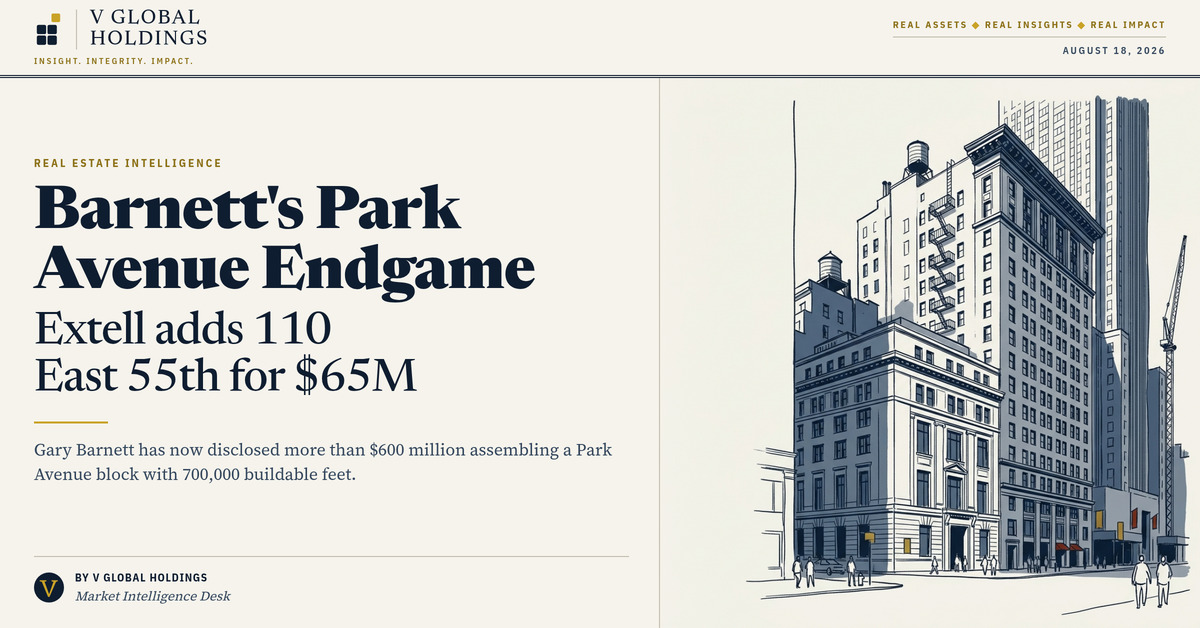
Gary Barnett just paid $65 million for a 73,000-square-foot office building that most of Midtown assumed he already controlled. If you only read the headline, you saw a mid-size office trade. If you read the property records for 110 East 55th Street, you saw something else entirely: the fourth disclosed piece of an assemblage that has now consumed more than $604 million in visible capital — and a development site that could carry 700,000 rentable square feet on one of the most valuable blocks in North America.
Here’s what you’ll take away from this breakdown: the real math behind the buy, why the timing of a discontinued foreclosure suit matters more than the price, and what Barnett’s pattern tells you about how assemblages actually get built in a market where nobody is supposed to be building.
The Deal, In Plain Numbers
Extell Development bought 110 East 55th Street from the Parkoff Organization for $65 million, according to property records. The building runs 73,000 square feet across 19 stories.
That pencils to roughly $890 per square foot for an existing Midtown office building — a number that should stop you, because it is not an office number. Trophy Midtown office has traded in that neighborhood; commodity prewar office has not, not in this cycle. Barnett did not buy a rent roll. He bought a footprint.
The building sits adjacent to 405–417 Park Avenue, the development site Extell acquired in May for $500 million. Add the $20 million of air rights purchased from Central Synagogue, and the $19 million paid earlier this year for the former Friars Club building at 57 East 55th Street, and the disclosed spend reaches $604 million. Extell also bought an office building at 165 East 56th Street in late May — price undisclosed — which means the true number is higher than $604 million, not lower.
What $604 Million Actually Buys
The assemblage carries approximately 527,000 square feet of as-of-right development, expandable to as much as 700,000 rentable square feet with additional air rights.
Run the two ratios:
- Against as-of-right: $604M ÷ 527,000 SF = roughly $1,146 per buildable foot
- Against the full 700,000 SF: $604M ÷ 700,000 SF = roughly $863 per buildable foot
That spread — $283 a foot — is the entire argument for why Barnett keeps buying. Every incremental air-rights transfer and every adjacent parcel does not just add square footage; it re-prices the land already on the books. The Central Synagogue air rights at $20 million are the clearest example. In isolation, a curiosity. Against 700,000 feet of program, they are the mechanism that drags basis down by hundreds of dollars a foot.
This is the part most operators miss when they watch an assemblage from the outside. The last parcel is never priced on its own income. It is priced on what it unlocks across everything already assembled.
The Foreclosure Suit Nobody Should Skip Past
Here is the detail that carries the most signal, and it appeared four paragraphs deep.
Before the sale, the Parkoff building was hit with a pre-foreclosure suit filed in May by an entity tied to construction company JT Magen, claiming the owner had defaulted and owed $40.6 million in principal and interest. That case was discontinued earlier this month — immediately before the sale closed.
Two facts sit on top of each other: JT Magen has previously partnered with Barnett, and the suit that clouded title went away right as Extell closed.
Read that sequence the way a capital-markets professional reads it. A distressed-adjacent seller, a lien-shaped pressure point, a discontinuance, a closing. Whatever the internal mechanics, the outcome is the one that matters to anyone assembling anything: the encumbrance cleared, and the parcel moved. Assemblages do not stall on price. They stall on the one owner who will not sell and the one lien that will not clear.
Every large Manhattan assemblage is ultimately a story about the holdouts and the encumbrances — not the price per foot. Price is negotiable. Title is not.
The Financing Tells You the Conviction
Barnett financed the deal with a $327 million loan from JPMorgan Chase, refinancing the original $218 million acquisition loan on the first site.
Sit with those two numbers. The debt on this assemblage went from $218 million to $327 million — a $109 million upsize — at a moment when the conventional wisdom says Midtown office development is uninvestable and large-format construction financing is scarce.
Three readings, and they are not mutually exclusive:
- A money-center bank underwrote the land, not the office market. JPMorgan is lending against a Park Avenue block, which is one of the last collateral types in the country that clears any credit committee.
- The refinance funded the acquisition. The upsize roughly covers the incremental parcels. The assemblage is partly financing its own expansion.
- Somebody has a tenant conversation underway. Nobody builds 700,000 feet of Midtown office on spec at this basis without a view on the demand side.
The Brook, and the Game of Development Chess
The remaining piece is 111 East 54th Street, home to the private club The Brook. Barnett is said to be pursuing it. Observers have speculated he intends to relocate The Brook into the former Friars Club building at 57 East 55th Street — the property Extell bought for $19 million.
If that is the plan, the $19 million was never an acquisition. It was currency. You do not pay a holdout in cash when the holdout does not want cash; you pay them in the thing they actually need, which for a 100-year-old private club is a comparable clubhouse on the same block. Buy the relocation site first, then negotiate from a position where you are offering a solution instead of a check.
That is the calculated game of development chess the reporting describes, and it is the single most transferable idea in this story.
What NYC Operators Should Take From This
- Trophy land is a separate asset class from office. The $890-per-foot print is a land comp, not an office comp. Do not let it into your building underwriting.
- Watch liens, not listings. The pre-foreclosure suit was the tell that 110 East 55th was in play, months before the deed moved.
- Basis is a moving target in an assemblage. Judge each parcel against the whole, not against its own income.
- Capital exists for the right collateral. A $327 million JPMorgan loan in this market is not a market signal — it is a collateral signal.
- Buy the relocation before you negotiate with the holdout. Solve their problem and the price conversation changes shape.
Representatives for Extell and the Parkoff Organization did not respond to requests for comment.
Your Move
The block between 54th and 56th on Park is being reassembled in public, one deed at a time, by a developer who has done this before and is telling you exactly how it works if you read the records instead of the headlines.
Pull the property records on the next assemblage in your own submarket. Look for the adjacent parcel with a lien, the air-rights seller with a balance-sheet problem, and the odd purchase that only makes sense as a relocation site. That is where the next $604 million story starts — and right now, almost nobody is looking.
What’s the most creative assemblage play you’ve watched work in your market? I want to hear it.