

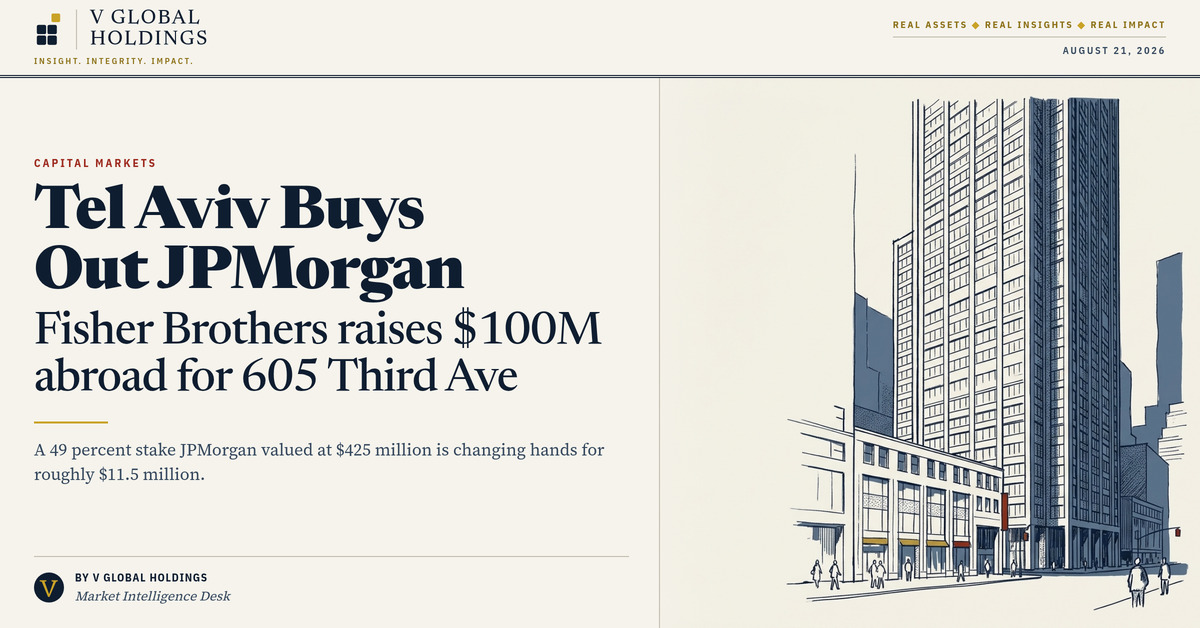
Here is the number that should stop you cold this morning. JPMorgan Asset Management listed its 49 percent interest in a 1 million-square-foot Midtown office tower last month at a $425 million valuation. Fisher Brothers is now set to buy that interest for approximately $11.5 million.
Both numbers are real. Both describe the same piece of paper. Understanding the distance between them is the single most useful thing a New York operator can do with the next four minutes.
This story is about 605 Third Avenue, but it is really about two things every one of us is living through right now: what a minority position in a leveraged office building is actually worth, and how much appetite is left in the Israeli bond market for American sponsors.
The Deal, In Plain Numbers
Fisher Brothers is turning to Tel Aviv. A British Virgin Islands entity tied to the firm filed a prospectus on the Tel Aviv Stock Exchange on August 13, seeking to raise roughly $100 million in unsecured bonds.
The asset stack looks like this:
- 605 Third Avenue — 43 stories, roughly 1 million square feet
- 84 percent leased
- $400 million senior mortgage against it
- JPMorgan’s 49 percent stake, marketed in July at a $425 million valuation
- Purchase price to Fisher Brothers: about $11.5 million
The proceeds do more than one job. Beyond the JPMorgan buyout, Fisher Brothers intends to fund capital expenditures, leasing costs across the existing portfolio, and general working capital.
Why $11.5 Million and Not $208 Million
If you take the $425 million valuation at face value, a 49 percent slice looks like it should trade north of $200 million. It does not, and the reason is one clause in the prospectus: the interest sits below the senior mortgage.
Run the waterfall. A $400 million first mortgage sits against a building carrying a $425 million headline value on an 84 percent leased rent roll. What is left over for equity — for all of the equity, before you split it 51/49 — is thin. A minority position in that residual, with no control, no unilateral exit, and a capital call obligation ahead of it, is not worth its pro-rata share of the gross. It is worth what someone will pay to be rid of it.
The lesson is not that JPMorgan mispriced the building. It is that “valuation” and “proceeds to a subordinate minority holder” are two entirely different conversations — and 2026 keeps proving it in public.
This is the pattern operators should internalize. Across Manhattan office right now, the gap between asset value and equity value is where the real repricing is happening. The building did not fall 97 percent. The subordinate slice did.
The Israeli Bond Market Is Being Tested — Right Now
Here is what makes this raise genuinely interesting rather than merely arithmetic.
American sponsors have used the Tel Aviv Stock Exchange for years for one blunt reason: cheaper capital. Fisher Brothers’ debt is expected to price at 6 to 6.5 percent, according to a source familiar with the matter. Try replicating that in the domestic unsecured market for a private real estate operator.
But the window has gotten drafty. Consider what Israeli investors have absorbed in the last ninety days:
- Simad Holdings — Michael and David Shabsels’ summer camp platform, owner of 30 U.S. camps, announced in May it would default on its bonds. Roughly $34 million of bond funds were diverted to entities the owners controlled. Bondholders are still expected to recover in full.
- GFI Capital — the New York firm told one class of Israeli bondholders this month it could miss payments absent a debt restructuring.
Fisher Brothers is walking into that room and asking for unsecured money. Unsecured means no lien, no collateral, no property-level backstop. Investors are buying the sponsor, not the building.
What Fisher Brothers Is Putting on the Table
To its credit, the firm is showing real balance sheet. Its initial Tel Aviv filings disclosed, as of year-end 2025:
- $5.4 billion in assets
- $460 million in revenue
- $220 million in net operating income
S&P Global Ratings Maalot assigned a preliminary ‘ilA+’ — investment grade.
And the operating record is not theoretical. Fisher Brothers signed one of the largest office leases in the entire country in 2023, when Paul, Weiss took 765,000 square feet on a 20-year deal at 1345 Sixth Avenue. At 605 Third itself, financial firm Karbone signed a 20,000-square-foot lease earlier this year at an asking rent of $120 per square foot.
That last figure deserves a second look. $120 per square foot at Third Avenue and 40th Street is not a distressed number. It is a Midtown trophy-adjacent number. Which brings us to the tension at the center of this deal.
The Contradiction Worth Sitting With
Read the two halves of this story side by side:
| Signal | What It Says |
|---|---|
| $120/SF asking rent on a new lease | The building is leasing at strength |
| 84 percent leased | Solid, with visible upside |
| $425M valuation on the stake listing | A serious asset |
| $11.5M actual price for 49 percent | The equity is nearly wiped |
Nothing here is inconsistent — it is just leverage doing what leverage does. A $400 million mortgage is a very large number to climb over before common equity sees daylight. The operating business is healthy. The capital structure is what got repriced.
There is also a quiet disclosure story here. Privately held real estate companies that tap Tel Aviv are required to publish financials and quarterly reports, often for the first time in their history. Fisher Brothers just showed the market $5.4 billion in assets and $220 million of NOI. That transparency is the price of the 6 percent coupon — and it is why this market keeps producing the cleanest data set we have on private New York sponsors.
What Operators Should Actually Do With This
Three takeaways I would act on:
- Reprice your minority positions honestly. If you hold a subordinate, non-controlling stake behind a large first mortgage, your carrying value is probably fiction. Run the waterfall at today’s cap rates before someone runs it for you.
- Watch the Fisher Brothers pricing print. If an investment-grade sponsor with $5.4 billion in assets clears at 6 to 6.5 percent unsecured, the Tel Aviv window is still open. If it prices wide — or pulls — assume that channel is closing for everyone behind them.
- Separate the asset from the capital stack. 605 Third is an 84 percent leased tower signing $120/SF leases. It is not a distressed building. It is a building with a distressed slice of equity. Buy accordingly.
The Bottom Line
Fisher Brothers is doing something rational and slightly audacious: using foreign unsecured debt to consolidate control of a Midtown tower at the exact moment the subordinate equity in that tower is worth almost nothing. If the building leases from 84 to 95 percent, that $11.5 million looks like one of the smartest checks written in New York this year. If the Israeli market slams shut behind Simad and GFI, the story reads differently.
Both outcomes are live. That is what makes it worth watching.
Are you seeing the same equity-versus-asset gap in your own portfolio — and are you marking it, or waiting? I want to hear the real numbers, not the appraised ones. Drop your view below.