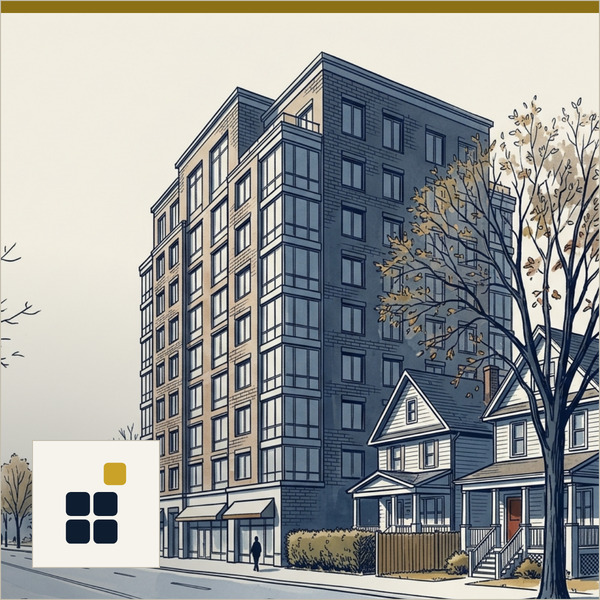
Flushing developer, Apex Development, spent the time and money to win a rezoning, got it in October, and still can’t build. The obstacle is a set of Flushing deed restrictions written in 1906, and the neighbors who are using them in court.
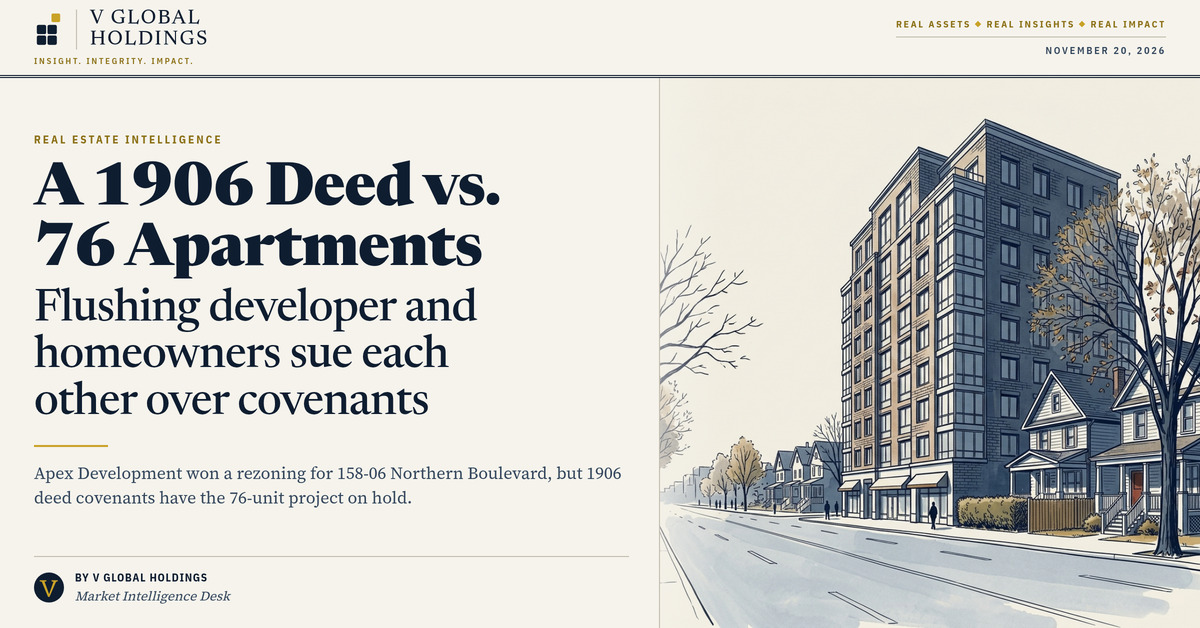
Here is what you’ll get from this piece: the facts of both lawsuits, the argument each side is making, why a city approval didn’t settle the question, and the title checks I’d run before paying for another rezoning.
What Happened
The Real Deal’s Elizabeth Cryan reported the story on Nov. 19. The site is 158-06 Northern Boulevard in Flushing, Queens. The developer is Apex Development, led by Andrew Esposito.
The project, as TRD describes it:
- Building: 10 stories, mixed-use
- Units: 76 apartments
- Affordable: 19 of the 76, which is 25 percent by my math
- Entitlement: Apex secured a rezoning for the project in October
- Status: on hold while the legal fights play out
The rezoning is done. The building is not moving. That gap is the whole story.
The 1906 Rule
The problem sits in the chain of title, and it has a name: the Rickert-Finlay Covenants.
According to TRD, these are 28 private deed restrictions established in 1906 by the developers of the Flushing subdivision and incorporated into property deeds beginning in 1920. They were meant to preserve what was then a park-like suburban neighborhood.
One provision is the one that matters here. It prohibits apartment buildings except in a specifically designated section of the subdivision. The Apex site falls outside that section.
TRD adds a detail worth keeping in view. Northern Boulevard is now a multilane commercial thoroughfare. The covenant describes a neighborhood that the boulevard itself no longer resembles.
| Year | Event |
|---|---|
| 1906 | Subdivision developers establish the 28 Rickert-Finlay Covenants |
| 1920 | Covenants begin to be incorporated into property deeds |
| 1964 | Broadway-Flushing Homeowners’ Association is founded to enforce them |
| October | Apex secures a rezoning for 158-06 Northern Boulevard |
| November | Developer and homeowners are suing each other; project on hold |
Two Lawsuits, Two Theories
Each side went to a different courthouse with a different argument.
The homeowners, in state court. Raymond and Barbara Ciccolilli live in a single-family home right next to the proposed building. They are suing Apex along with the Broadway-Flushing Homeowners’ Association. TRD reports the association was founded in 1964 specifically to enforce the covenants, and that it says it tried unsuccessfully to negotiate with Apex during the rezoning process. Their position is simple: the deed says no apartment buildings here, and this is an apartment building.
The developer, in federal court. Apex is asking a federal court to throw the restrictions out. Per TRD, it makes two arguments:
- Fair Housing Act. Apex argues that enforcing a prohibition on multifamily housing would violate the federal Fair Housing Act because it disproportionately excludes minority and lower-income renters.
- Changed conditions. Apex argues the covenants are relics of an era when the area was a suburban enclave of stables and single-family homes, and that decades of change have rendered them obsolete. Its complaint says the property has been used for commercial purposes for decades, including as a restaurant and a dialysis center.
| Homeowners | Apex Development | |
|---|---|---|
| Court | State | Federal |
| Parties | The Ciccolillis and the homeowners’ association | Andrew Esposito’s Apex |
| Claim | The 1906 covenants bar apartments on this lot | The covenants violate the Fair Housing Act and are obsolete |
| Goal | Block the 10-story building | Remove the restrictions |
Neither court has ruled. I’m not going to predict the outcome, and nobody underwriting a similar site should either.
Esposito gave TRD his position directly:
“We take community relations very seriously and we remain willing to find an amicable solution, but we believe housing is a critical necessity right now, and we’re not going to be discouraged by 120-year-old restrictive covenants.” — Andrew Esposito, Apex Development, to The Real Deal
A lawyer for the homeowners’ association declined to comment to TRD.
Why the Rezoning Didn’t End It
This is the part I’d want every acquisitions analyst to sit with.
A rezoning is the city deciding what it will allow on a lot. A deed covenant is a private restriction that runs with the land. They are two separate systems, and one does not automatically cancel the other. The city said yes. The neighbors still have a document that says no, and they’ve gone to court to enforce it.
So Apex now carries a risk that has nothing to do with the City Council, the community board or the Department of City Planning. It’s a title risk, and it showed up after the entitlement was in hand.
Three things stand out to me as an operator:
- The opponent was organized before the developer arrived. This association has existed since 1964 for exactly this purpose. That’s 62 years of institutional memory about one set of covenants. It isn’t a group that formed over a single project.
- The commercial history didn’t prevent the fight. A restaurant and a dialysis center operated on this property, according to Apex’s complaint. Prior non-residential use may help the changed-conditions argument, but it didn’t stop a suit over an apartment building.
- The affordable units are in limbo too. Nineteen affordable apartments are part of the 76. They are on hold with everything else.
The Checklist I’d Run
None of this is legal advice. It’s how I’d change my own process after reading this story.
- Read the title report before the zoning analysis. On any site in an old planned subdivision, pull the recorded covenants first. Read the actual instrument. A summary line in a title commitment won’t tell you whether apartments are barred.
- Ask who can enforce. A covenant nobody polices is a different risk from one with a standing association behind it. Find out whether an enforcing body exists and whether it has sued before.
- Map the restriction, not just the lot. Here the covenant allows apartments in one designated section and bars them elsewhere. Which side of that line a site sits on is a diligence item, and it’s answerable before closing.
- Price the litigation into the schedule. If a covenant fight is plausible, the carry during it belongs in the pro forma. So does a scenario where the building doesn’t happen.
- Negotiate early and document it. The association says it tried to negotiate during the rezoning. Whatever happened in those conversations, the time to reach a recorded agreement is before the entitlement spend, when both sides still have something to trade.
- Tell your lender and your partners. A private restriction that can stop the project is material to a construction loan and to an LP. Disclose it up front.
Why This One Matters Beyond Flushing
Apex’s Fair Housing Act argument is the piece with reach. If a federal court accepts that enforcing an old ban on multifamily housing has a discriminatory effect, that reasoning could matter to other covenant-bound neighborhoods. If the court rejects it, homeowner groups elsewhere will have a recent example of covenants holding up against a city-approved project.
Either way, the city has been rezoning to add housing, and this case tests whether private restrictions written generations ago can override those approvals lot by lot. I’ll be following both dockets.
The Bottom Line
Apex did the hard public part. It won a rezoning for a 76-unit building with 19 affordable apartments on a commercial boulevard. A deed provision from 1906 and an association founded in 1964 have it stopped anyway.
The takeaway isn’t that covenants always win. Nobody knows that yet. It’s that entitlement risk and title risk are separate lines, and this deal shows what happens when the second one surfaces after the first is resolved.
Your move: pull the title report on the next development site in your pipeline and read the recorded restrictions yourself, start to finish, before the next zoning meeting.
Have you ever had a private deed restriction stop or reprice a deal after the zoning was cleared? Tell me how it played out in the comments.