

Pickleball clubs were the easy answer for every landlord with a dark box in 2023. A vacant junior anchor, a sport adding millions of players a year, and an operator willing to sign. Three years later, the sport is still growing and a chunk of those leases are going bad. Bisnow’s reporting this week lays out why, and the lesson has very little to do with pickleball.
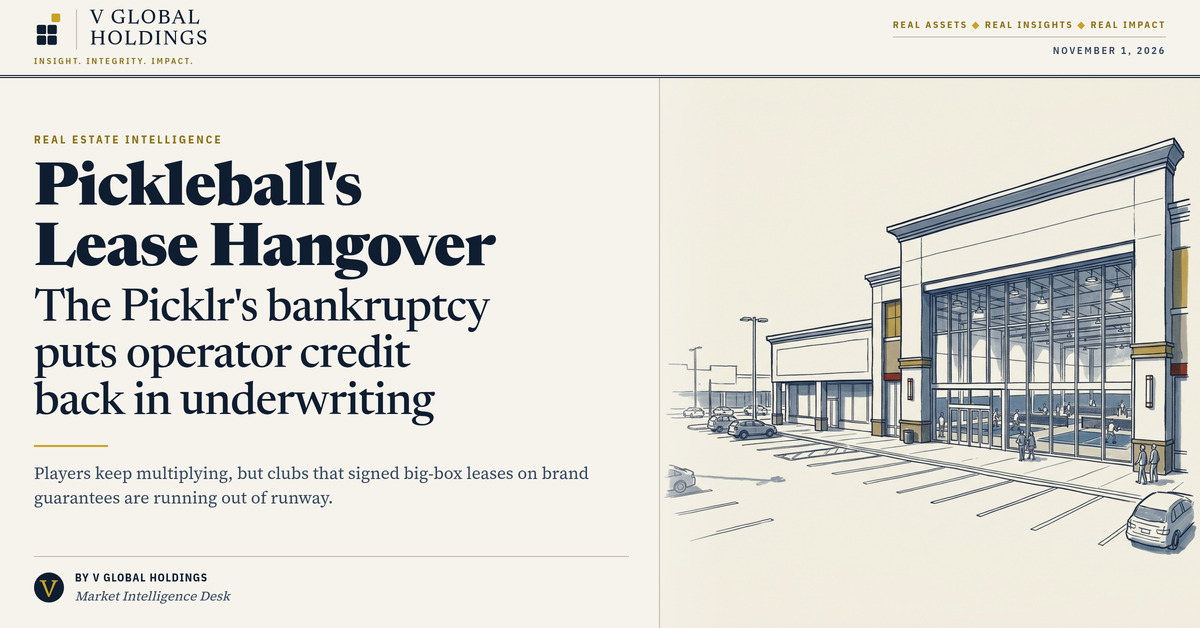
If you own retail, lend against it, or underwrite experiential tenants of any kind, this is worth five minutes. Below: the numbers behind the shakeout, what actually broke at The Picklr, the per-court math that sinks a 10-court club, and the checklist I’d pull out of it for the next “demand driver” that walks into your leasing office.
Demand Never Left. Supply Overshot.
Start with the part that surprises people. Participation is not the problem.
The Sports & Fitness Industry Association’s 2026 Single Sport Report puts pickleball at more than 24 million players last year, up from nearly 20 million in 2024. That is roughly 23% growth in a single year.
What changed is supply, and the pace of new supply:
- Public court growth across the 100 biggest U.S. cities fell from 14% in 2024 to 4% in 2026, per Axios.
- Six prominent brands, The Picklr among them, still opened more than 50 new clubs in the first nine months of 2026.
- There are roughly 735 indoor clubs nationally, and at the 20,000 to 40,000 SF that FRANdata says brands typically need, that is likely more than 14.7 million SF of indoor space devoted to the sport.
Cultural attention crested in late 2024, according to FanEquity. The build-out kept going for nearly two more years. That gap is where the trouble lives.
“As people were catching the pickleball bug, they were a little bit pie-in-the-sky about how their business models could look, and they accepted real estate deals that they probably shouldn’t have because they were overly bullish.” — Ross Chaifetz, Chaifetz Group
What Actually Broke at The Picklr
The Picklr is the case study, and the details matter more than the headline.
- Founded in 2021, began franchising in 2023.
- Hit a $59M valuation in 2024.
- Sold more than 300 franchises by mid-2024, with plans for clubs in 32+ states.
- Actually operated 76 franchise locations before its parent filed for bankruptcy on Oct. 9.
- Generated $10.3M in revenue last year and still lost $4.4M, with about $19M in total liabilities by the end of Q1.
CEO Jorge Barragan told the Sports Business Journal the filing stemmed from lease guarantees for around 40 early franchisees that became too costly for the company.
Read that twice. The franchisor did not fail because players stopped showing up. It failed because it put its own balance sheet behind its franchisees’ rent, at a scale its revenue could not carry. A $10M-revenue company guaranteeing dozens of 20,000-plus SF leases is a credit problem dressed up as a growth story.
And it is not alone. PickleRage and Pickleball Kingdom have also shuttered franchise locations.
The Per-Court Math
Here is the unit economics, using figures Heleus Holdings CEO West Shaw laid out for The Dink and Johns Design & Consulting’s performance data:
| Line item (10-court club) | Monthly |
|---|---|
| Rent, 20K to 40K SF | $30,000 to $50,000 |
| All-in costs at $50K rent (payroll, utilities, upkeep, marketing, inventory) | $85,000+ |
| Revenue at ~$8,000 per court | ~$80,000 |
At the top end of the rent band, a 10-court club grosses about $80,000 a month against $85,000-plus of costs. Shaw’s conclusion: a club needs more than $1M a year just to break even.
That is a thin business before you add a slow membership ramp, a new competitor two exits down the highway, or a sunny market where, as Custom Capital CEO Jason Milton put it, playing outside is free. Indoor clubs charging $40 to $50 a month are competing with a public court that costs nothing.
Rent is the one line the operator cannot flex. Payroll can be cut and marketing paused. The lease is fixed for ten years.
Who Is Still Winning
The operators holding up share one trait: pickleball is the hook, not the whole business.
- Painted Pickle in Atlanta: 33,000 SF, eight indoor courts, a full restaurant and bar, mini golf, a putting green, darts and a live music stage. No membership model, and a heavy private and corporate events book.
- CityPickle in New York: strong food and beverage, per Avison Young’s Patrick Steffens. Two NYC-area locations at 10,000 and 37,000 SF, a 60,000 SF club coming to Brooklyn and a 100,000 SF venue in Boca Raton.
Painted Hospitality CEO Justin Amick’s argument is that memberships are the first thing households cut when gas and groceries squeeze the budget. A pay-to-play venue with a bar tab has more ways to make money on a Tuesday night.
“If you’re just offering traditional pickleball programming, that’s not going to cut it.” — Ross Chaifetz
What This Means for Landlords
The good news for owners: retail can absorb this. Colliers put national retail vacancy at 4.3% in Q3, near historic lows, and JLL’s John Brecher says well-located junior anchor space still draws a range of tenants in Northern California, even with leasing paused on oversupply.
The real change is in underwriting. Brecher’s read is the one to keep:
“Landlords will look harder at the strength of the operator actually signing the lease: the franchisee’s own financials, operating experience and local track record. They’ll rely less on the brand name or a corporate guarantee.”
That is the whole lesson. A corporate guarantee is only as good as the corporation, and a franchisor’s guarantee is often backed by franchise fees from the same tenants it is guaranteeing.
My Checklist for the Next “Demand Driver” Tenant
Pickleball will not be the last category that shows up promising foot traffic. Before you sign the next one:
- Underwrite the signing entity, not the logo. Pull the franchisee’s own financials and operating history.
- Stress the guarantor. Ask how many other leases it is backing, and what its revenue is against that total exposure.
- Run the unit math yourself. Revenue per court, bay or simulator against rent plus a realistic opex load. If breakeven needs peak utilization, pass or reprice.
- Map the trade area’s pipeline, not just today’s competitors. Supply announced is supply that will open.
- Prefer diversified concepts. Food, beverage and events give the tenant more than one way to pay rent.
- Protect re-tenanting. Limit landlord TI on purpose-built buildouts, and keep the box convertible back to conventional retail.
The Takeaway
Pickleball is not a fad. Twenty-four million players say otherwise. But a sport can keep growing while the real estate built for it gets overbuilt, and the operators who signed long leases on brand guarantees are now paying for that gap.
If you have an experiential tenant in your rent roll, now is a good time to re-read the guaranty and rerun their per-unit math. If you are looking at one of these boxes coming back to market, the 4.3% vacancy backdrop says you have options. Use them.
What’s your read: are experiential tenants still worth the TI, or are you underwriting them like any other credit now? I’d like to hear from people with one in their rent roll.