
A $10 million commission dispute between one of the world’s largest brokerages and one of its most famous auction houses just ended quietly. No disclosed terms. No comment from either side.
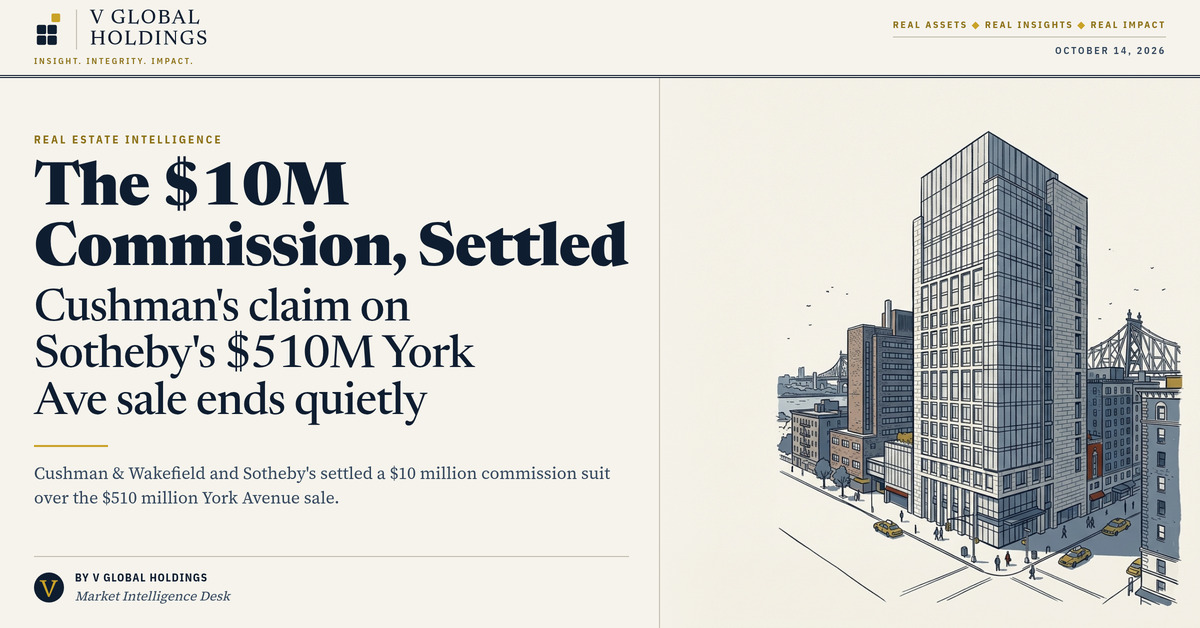
If you broker, advise or own institutional real estate in New York, this post gives you what TRD reported, the numbers behind the claim, and the five lessons I would take back to my own deal files.
One note up front. Everything about the underlying dispute is an allegation made in a complaint. Sotheby’s called it baseless. I am relaying the reporting, and any opinion is labeled as mine.
The Settlement in One Table
According to TRD, here is where things stand:
| Item | Detail |
|---|---|
| Parties | Cushman & Wakefield (plaintiff) vs. Sotheby’s |
| Property | 1334 York Avenue, Sotheby’s Upper East Side headquarters |
| Buyer | Weill Cornell Medicine |
| Sale price | $510 million, October 2025 |
| Amount claimed | $10 million commission; $10.2 million billed in December |
| Suit filed | April |
| Settlement | Parties notified the court last month |
| Court | New York State Supreme Court, filing signed by Justice Melissa Crane |
| Terms | Not disclosed; both sides declined to comment |
Read that last row twice. We know the case is over. We do not know who paid what, or whether anyone did.
What Cushman Alleged
TRD reports that Cushman sued Sotheby’s in April, accusing the auction house of breaching a commission agreement tied to the October 2025 sale of 1334 York Avenue to Weill Cornell Medicine.
The brokerage’s story, as the complaint tells it:
- Cushman spent years brokering a 200,000-square-foot lease at the building on behalf of Weill Cornell.
- That lease, Cushman claimed, paved the way for the $510 million sale.
- At the 2023 lease signing, Cushman alleged, both sides signed a separate agreement entitling the firm to a 2 percent commission on any sale to Weill Cornell during the 30-year lease term.
- Sotheby’s allegedly never told the brokerage it was weighing a sale. Cushman says it first learned of the deal through news reports.
- Cushman sent a $10.2 million commission bill in December, and Sotheby’s refused to pay.
Here is the line from the suit that explains why this one had teeth:
“choosing instead to retain those funds to address its deteriorating financial condition” — Cushman’s lawsuit, as quoted by TRD, alleging why Sotheby’s refused to pay the commission bill
That is a serious accusation about motive. It is also only an accusation. Keep that in mind as we go.
The Math Behind the Claim
My math, not TRD’s: 2 percent of $510 million is $10.2 million. That matches the amount TRD says Cushman billed in December.
| Input | Figure | Source |
|---|---|---|
| Sale price | $510,000,000 | TRD |
| Alleged commission rate | 2% | TRD (per complaint) |
| Implied commission | $10,200,000 | My calculation |
| Amount billed | $10.2 million | TRD |
I like when a claim reconciles to the dollar. It tells me the alleged agreement was simple enough to compute on a napkin. Whether it was enforceable, who owed what, and whether the deal terms were met are the questions a court would have had to answer. The settlement means we will not get that answer.
The Sotheby’s Side
TRD reports that Sotheby’s, at the time of the filing, called the lawsuit “baseless and completely meritless.”
Both sides declined to comment on the settlement itself. Silence is common after a settlement, but it leaves the public record with one detailed version of events (the complaint) and one short denial.
My read: when only one side’s narrative is on paper, readers tend to fill in the blanks. Do not. The reporting gives us allegations, a denial and a quiet ending.
The Financial Backdrop
The complaint, per TRD, painted Sotheby’s as financially strained and trying to shed debt tied to the property, including a $175 million mortgage.
Cushman alleged the Weill Cornell lease was “a financial life-preserver to Sotheby’s” that boosted the property’s value and helped Sotheby’s command a hefty price. TRD notes the building traded for almost 40 percent more than the auction house paid in 2009.
Sotheby’s itself acknowledged the upside. After the sale, CEO Charles F. Stewart told staff in an email that the move would be “very financially beneficial,” with proceeds going to reduce debt and fund investments. TRD attributes that to an article in The Art Newspaper cited in the lawsuit.
The sale also capped a run of real estate moves, per TRD:
- A year before the Breuer deal: Sotheby’s bought a converted office building, Gantry Point in Long Island City, for $82 million.
- 2023: It bought the landmark Breuer Building from the Whitney for about $100 million.
- October 2025: It sold 1334 York Avenue to Weill Cornell Medicine for $510 million.
What Operators Should Take From This
This is my read, not a finding. I am not a lawyer, and nothing here is legal advice. The facts of the dispute were never tested in court. But the structure of the allegation is worth stress-testing against your own files.
- Side agreements need a home. The alleged commission deal was a separate agreement from the lease. If your fee rights live in a standalone document, make sure someone owns tracking it for the full term.
- Thirty years is a long time. The alleged right ran across a 30-year lease term. Staff turns over, ownership changes and leadership forgets. Calendar the triggers.
- Who finds out first? Cushman says it learned of the sale from news reports. If you hold a purchase-related fee right, ask whether you have a notice requirement and whether it is written clearly.
- Price the pursuit. A $10 million claim justified a lawsuit against a counterparty. Smaller fees often do not. Know your threshold before you need it.
- Preserve the relationship math. Brokerages and owners cross paths again. A settlement can protect that. I have no view on whether it did here, and the reporting does not say.
None of that presumes either side was right. It is how I would audit my own deal documents after reading this.
Why This Matters Beyond One Building
For New York investors and brokers, the story sits at the intersection of leasing and capital markets. A brokered lease can raise a property’s value. When that tenant later becomes the buyer, the question of who gets credit becomes a real one.
TRD’s reporting does not tell us how the parties resolved it. In my view, that silence is the lesson. Undisclosed settlements keep the market guessing about what a court would have said, and that makes written terms at the front end more valuable, not less.
What I’ll Be Watching
- Whether either party discusses the resolution publicly, though both declined to comment.
- Whether more tenant-to-buyer scenarios surface in NYC, where a brokered lease later feeds a sale.
- How institutional owners such as Sotheby’s continue to manage real estate, given the pattern TRD describes across the Breuer Building, Gantry Point and 1334 York Avenue.
Until there is more reporting, I would treat the dispute for what it is: allegations, a denial and an undisclosed settlement.
Your Turn
Here is my question for the NYC CRE community. If you hold a commission or fee right tied to a future sale, how do you track it over a multi-decade lease, and who at your firm would know to send the bill?
Tell me what has worked for you. Drop it in the comments or send me a DM.
Source: The Real Deal.