$888,000 a Key in Midtown for seller Azora
American capital keeps asking whether New York hotels have recovered. European capital stopped asking and started buying.
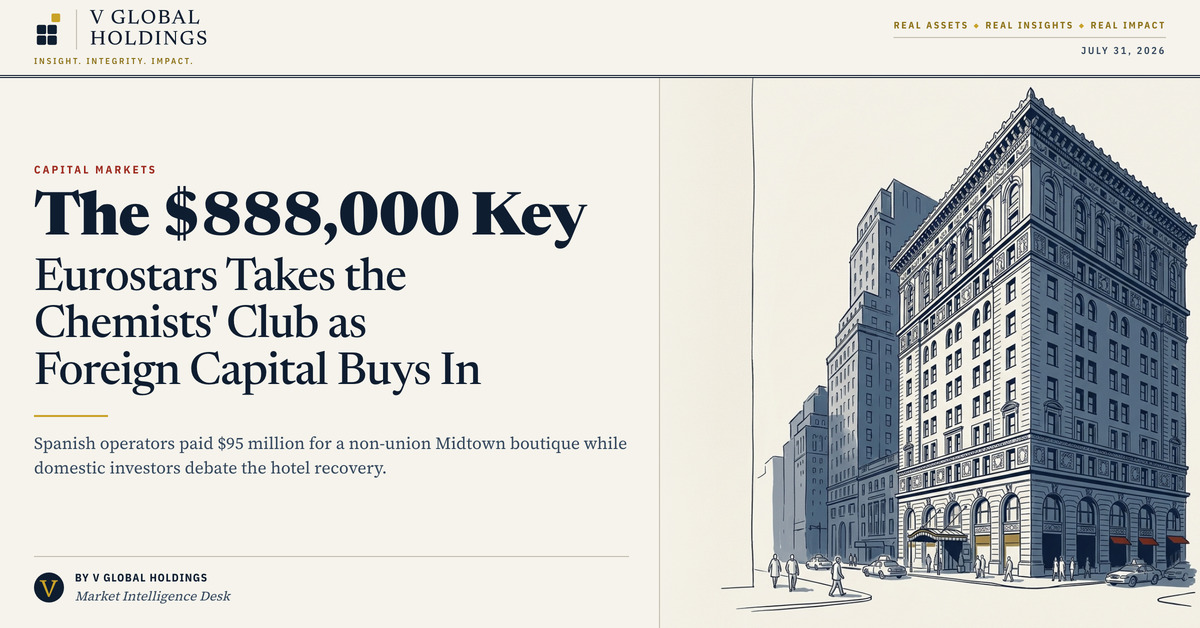
Barcelona-based Eurostars Hotel Company just paid about $95 million for the 107-key Chemists’ Club Hotel at 52 East 41st Street — roughly $888,000 per key for a recently renovated, non-union property a block from Grand Central. The seller: Spanish investment firm Azora. Eastdil Secured advised the seller.
If you want a single data point that captures where NYC hospitality is trading and who’s writing the checks, this is it. Let’s break down the price, the pattern, and the operating reality the buyer is stepping into.
💵 The Deal Sheet
- Property: Chemists’ Club Hotel, 52 East 41st Street, Midtown Manhattan
- Keys: 107
- Price: ~$95 million
- Price per key: ~$888,000
- Buyer: Eurostars Hotel Company (Barcelona) — owned by Grupo Hotusa
- Seller: Azora (Spanish investment firm); acquisition date unclear
- Broker: Eastdil Secured (sell side; declined to comment)
- Building: 16-story Beaux-Arts, built 1911, near Grand Central Terminal
- Ground-floor tenant: Benjamin Steakhouse, in place since 2006
- Labor status: non-union
- Condition: recently renovated
Azora and Eurostars did not immediately respond to requests for comment.
🔄 A Homecoming, Technically
The chain of title here is almost novelistic.
Fortuna Realty Group, led by Morris Moinian, developed the property — then known as the Dylan — and sold it to Grupo Hotusa and Losan Hotels World for $78 million in 2007.
Hotusa owns Eurostars. So this purchase brings the asset back into the same corporate family that owned it nearly two decades ago.
The building’s own history is worth a paragraph. Constructed in 1911, it served for decades as a private clubhouse for members of the chemistry profession — complete with research laboratories, a scientific library and social spaces. It converted to the Dylan Hotel in 2000. And in 2002, Britney Spears opened a short-lived restaurant inside it.
Chemists’ library → boutique hotel → celebrity restaurant → Spanish institutional trade at $888K a key. That’s Midtown.
Eurostars now owns and operates seven hotels across the United States, including one on Wall Street, plus properties in Boston, Chicago, Miami and Washington, D.C. This isn’t a tourist purchase — it’s an expansion of an existing U.S. platform.
🌍 The Real Story: Foreign Capital Is Taking the Other Side of the Trade
This deal isn’t an outlier. It’s the fourth data point in a pattern that’s been building all year.
| Buyer | Origin | Asset | Price | Timing |
|---|---|---|---|---|
| Meliá Hotels International | Spain 🇪🇸 | Nomad Hotel | $203M | June 2026 |
| Generation Essentials Group | France 🇫🇷 | Tribeca Hilton Garden Inn | $69M | March 2026 |
| Fattal Hotel Group | Israel 🇮🇱 | The Blakely | $38.5M | This month |
| Eurostars (Grupo Hotusa) | Spain 🇪🇸 | Chemists’ Club Hotel | ~$95M | This week |
Four foreign buyers. Four Manhattan hotels. Roughly $405 million in disclosed volume — and that’s just the transactions named in this one article.
Why is overseas capital more aggressive here than domestic capital?
- Different cost of capital. European operators with lower home-market financing costs and long holding horizons underwrite differently than U.S. funds targeting near-term IRRs.
- Operator advantage. These are hotel companies, not allocators. They buy operations, plug in existing platforms, and capture management economics a passive investor can’t.
- Currency and cycle timing. Buying a dislocated asset class in a global gateway city is a classic patient-capital play.
- They’re pricing recovery, not the present. Which brings us to the uncomfortable part.
⚠️ The Operating Picture They’re Underwriting Into
Here’s what makes $888,000 per key a genuinely interesting bet rather than an obvious one. New York hospitality is still carrying real damage:
- NYC hotels employ 12.9 percent fewer workers than before Covid, per a recent state comptroller report
- Visitor volumes remain 2.4 percent below 2019 levels
- Owners continue to grapple with higher operating costs and weaker international tourism
- The recovery has been slower than expected
And on the labor side, a new agreement includes the largest pay increases in the nearly 100-year history of the Hotel and Gaming Trades Council — putting significant additional pressure on owners of union hotels.
Now re-read one line from the deal sheet: the Chemists’ Club is a non-union hotel.
In a market where union labor costs just stepped up more sharply than at any point in the trades council’s century-long history, non-union payroll flexibility isn’t a footnote in the underwriting. It may be the single largest driver of the price.
That’s the thesis in one sentence: buy a renovated, non-union, 107-key boutique next to Grand Central, and you own an asset whose margin structure is insulated from the cost shock hitting the union stock across the street.
🧠 Five Takeaways for CRE Operators
- Union status is now a pricing input, not a disclosure item. After this contract, model union and non-union hotel assets as separate risk classes. The labor-cost delta compounds every year of the hold.
- Per-key is the honest metric. $95 million sounds like a Midtown mid-market trade. $888,000 per key tells you it’s a luxury boutique basis. Always convert.
- Watch who’s bidding, not just what’s clearing. When four consecutive gateway hotel trades go to foreign operators, domestic capital is either priced out or looking the wrong direction. Both are actionable signals.
- Renovated is worth a premium right now. With construction and FF&E costs elevated, a recently completed renovation removes a large, uncertain capex line from the buyer’s model.
- Location beats macro. Visitor volume is still below 2019 — but a Beaux-Arts boutique steps from Grand Central isn’t underwriting citywide averages. It’s underwriting a commuter-and-corporate catchment that has recovered far faster than the tourist trade.
🎯 The Bottom Line
Spanish capital just paid $888,000 a key for a 115-year-old former chemists’ clubhouse in Midtown, buying it back into the same corporate family that owned it in 2007 — while U.S. investors are still debating whether New York hotels have bottomed.
Employment is down 12.9 percent. Visitors are down 2.4 percent. Union labor costs just posted their largest increase in a century. And foreign operators have committed north of $400 million across four Manhattan hotels in five months.
Somebody is reading this market wrong. The transaction record says it isn’t the buyers.
If you’re evaluating NYC hospitality, run one screen this week: pull every Manhattan hotel trade of the last 12 months, tag each by union status and price per key, and see how wide the spread really is. I suspect it’s wider than most models assume. What’s your read — is foreign capital early, or are they buying a recovery that hasn’t been earned yet? 👇