
Michael and David Shabsels camp misfire
Every real estate cycle produces a cautionary tale, and 2026 has found its defining one. Two brothers from Park Slope built a half-billion-dollar summer camp and real estate empire — 30 camps, a 55-asset property portfolio, 20,000 campers a season — almost entirely on borrowed money. Then it collapsed into bankruptcy, an Israeli securities investigation, and a $34 million hole nobody can fully account for.
This is a story about leverage. Specifically, it’s about what happens when leverage stops being a tool and becomes a religion. If you build or finance real estate, the Shabsels saga is worth your full attention — not for the spectacle, but for the structural lessons buried in the wreckage. In the next few minutes, we’ll trace how it was built, how it broke, and what disciplined operators should take away. Let’s dig in.
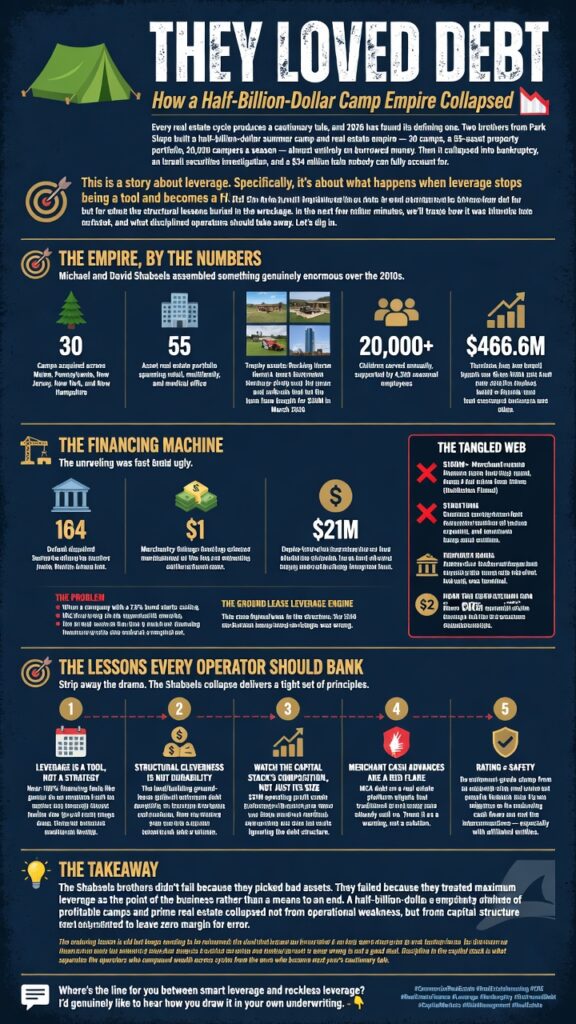
🎯 The Empire, By the Numbers
Michael and David Shabsels assembled something genuinely enormous over the 2010s:
- 30 camps acquired, primarily across Maine, Pennsylvania, New Jersey, New York, and New Hampshire
- A 55-asset real estate portfolio spanning retail, multifamily, and medical office
- Trophy operating assets: Rocking Horse Ranch Resort, SplashDown Beach waterpark, and One Canal Place, a 32-story New Orleans office tower bought for $28 million in March 2026
- 20,000+ children served annually, supported by 4,300 seasonal employees
- A flagship camp appraised at $466.6 million (Leitner Berman), throwing off $160 million in 2024 revenue and $21 million in operating profit
On the surface, this looked like a thriving, cash-generative enterprise. The camps made real money. The problem was never the operations. The problem was the capital stack.
🏗️ The Financing Machine
Here’s where it gets instructive. The Shabselses raised $214 million in bonds on the Israeli capital market at a 7.5% rate, backed by an investment-grade rating from Midroog (a Moody’s affiliate). They stacked on a staggering $234 million in merchant cash advance debt across multiple firms. And their real estate arm, Damis Holdings, carried $466 million in outstanding mortgages.
But the real engineering was in the structure. The brothers deployed a ground-lease strategy that reads like a leverage master class gone wrong:
- Purchase a property outright.
- Immediately carve it into a ground lease, splitting land from building.
- Obtain mortgages on both the land and the building.
- Become both lessor and lessee through affiliated entities.
- Achieve near-100% financing on the asset.
“They loved debt. They wanted as much leverage as they could.” — an unnamed source in the reporting
Read that structure again. By sitting on both sides of the ground lease, they manufactured financeable value out of assets they’d just bought — extracting close to the full purchase price back out as debt. It’s brilliant, right up until a single payment slips.
💥 How It All Came Apart
The unraveling was fast and ugly:
- Late May 2026 — Default discovered. A $34 million diversion of funds surfaced, with the destination still unclear.
- June 2026 — Bankruptcy filings; emergency court approvals just to keep camps operating through the season.
- $60 million in debtor-in-possession financing approved to stop the bleeding.
- Israeli securities authorities opened an investigation; restructuring officers began tracing the tangled camp-and-real-estate interconnections.
One creditor filing captured the state of play with grim wit:
“This case is beyond a ‘melting ice cube’ — the ice cube is a puddle.”
Layer in the merchant cash advance claims — $100+ million from Simad, $134 million from Damis — and the litigation from camp partners like the Bellottos (suing over a $620K investment) and disputes with TriState Capital over a $23 million loan, and you have a capital structure so interwoven that no one, including the restructuring officers, can cleanly untangle it.
🧩 Why Merchant Cash Advances Are the Real Villain
Pause on the $234 million in merchant cash advance debt, because this is the detail most operators will gloss over — and shouldn’t.
Merchant cash advances are the payday loans of the business world: fast, expensive, and structured to pull cash daily from receivables. When a company with a 7.5% bond starts stacking MCA debt on top, it’s not opportunistic financing. It’s a liquidity distress signal wearing a suit. By the time you’re funding a real estate empire with merchant cash advances, the conventional lenders have already priced you out — you just haven’t admitted it yet.
The tell was there all along. An investment-grade Israeli bond and a nine-figure MCA book do not belong on the same balance sheet. One of those ratings was wrong.
🎯 The Lessons Every Operator Should Bank
Strip away the drama and the Shabsels collapse delivers a tight set of principles:
- Leverage is a tool, not a strategy. Near-100% financing feels like genius in an up market and becomes a noose the moment cash flow hiccups. If your entire model depends on continuous refinancing, you don’t own assets — you rent them from your lenders.
- Structural cleverness is not the same as durability. The land/building ground-lease split extracted maximum debt, but it also created a fragile, opaque web where one default cascades everywhere. Complexity you can’t unwind in a crisis is a liability, not an asset.
- Watch the capital stack’s composition, not just its size. Good operating profit ($21 million on the flagship) coexisted with catastrophic financing. The camps were healthy; the balance sheet was terminal. Never let strong operations lull you into ignoring the debt structure funding them.
- Merchant cash advances are a red flare. For yourself or for a partner, MCA debt on a real estate platform signals that traditional credit has already said no. Treat it as a warning, not a solution.
- Rating ≠ safety. An investment-grade stamp from a respected agency did not prevent a $214 million default. Do your own diligence on the underlying cash flows and the interconnections — especially when affiliated entities sit on both sides of every deal.
💡 The Takeaway
The Shabsels brothers didn’t fail because they picked bad assets. They failed because they treated maximum leverage as the point of the business rather than a means to an end. A half-billion-dollar empire of profitable camps and prime real estate collapsed not from operational weakness, but from a capital structure engineered to leave zero margin for error.
The enduring lesson is old but keeps needing to be relearned: the deal that can only survive if nothing ever goes wrong is not a good deal. Discipline in the capital stack is what separates the operators who compound wealth across cycles from the ones who become next year’s cautionary tale.
Where’s the line for you between smart leverage and reckless leverage? I’d genuinely like to hear how you draw it in your own underwriting. 👇
#CommercialRealEstate #RealEstateInvesting #CRE #RealEstateFinance #Leverage #Bankruptcy #DistressedDebt #CapitalMarkets #RiskManagement #RealEstate